
Moose, elk, grizzlies and caribou are on Anand Yegnaswami's mind as he recalls a trip to Alaska's Denali National Park
Alaska was a part of Russia until 1867 when US Secretary of State William H Seward played a key role in purchasing it for $7.2 million. It is believed that the Russians were keen on the sale as having the Americans in their backyard would be a deterrent against the English. Most Americans felt that it was foolish to buy this barren patch of land and mockingly referred to the deal as “Seward’s Folly”. Mr Seward it appears was a man of profound foresight for despite the criticism he had mentioned that his greatest achievement was “the purchase of Alaska – though it will take people a generation to find it out.” Five generations later, I had an opportunity to seek out the truth myself.

The Thursday before Labor Day 2008, shortly before 11:30 pm (Alaska Time), Raghavan and Rajrishi from SFO, and I from Seattle landed at Anchorage’s Ted Stevens International Airport, picked up our rations at a nearby grocery store, and headed to Denali National Park.
Denali, which means “the tall/high one” in the Athabaskan language, is the highest peak in North America. The region around Denali, designated as the Denali National Park, is abundant in fauna. However, we were also hoping for a clear day to catch a glimpse of the peak itself, which is covered by clouds for most of the year.
Back at Anchorage, we were out on the Glenn Highway headed for Wasilla. Shortly after midnight of August 2008 (Alaska Time), John McCain announced Alaska governor Sarah Palin as his running mate for the 2008 Presidential Elections. I would like to think it was a mere coincidence that we passed by the town that day, for the quest we were actually on was Denali.

The road to Denali was desolate and serpentine with frequent changes in elevation. Quite often we would see light on the horizon and mistake it for the Northern Lights (Aurora Borealis). Whether this was the effect of fatigue from the long travel or a case of highway hypnotism we do not know. However, we made the same mistake knowing well that we could not expect to see the auroral phenomenon at that time of year. We saw some moose beside the highway in the early hours of the day and just about daybreak we reached the Park Visitor Center.
The Denali National Park is the only US National Park that does not allow personal vehicles inside the park. However, the authorities have ensured that ample shuttle buses are available to travel within the park. Shuttle buses are available for Toklat River (6.5 hours round trip), Eielson Visitor Center (8 hours round trip), Wonder Lake (11 hours round trip), Kantishna (13 hours road trip). Our plan for Day 1 was the Eielson Visitor Center option as the duration seemed reasonable and we had planned to upgrade it to a Wonder Lake trip if Mt Denali was visible. Though we made enquiries about the Discovery Hiking Tour for day 2, they were sold out. It was a cloudy day and it seemed unlikely that Mt Denali would be visible, yet we crossed our fingers and got into the bus.
 |
| Moose in Alaska (Douglas Brown/ Flickr) |
On the trip to the Eielson Visitor Center, we passed a few solitary moose. The bus driver forewarned us to keep a safe distance from them while we were in the park, since it was the rutting season and solitary males were known to be very aggressive. After crossing the Savage River we came across a herd of caribou (Rangifer tarandus). Also known as Reindeer in Europe, these deer are both migrant and resident. The migrant herds are known to travel up to 5,000 kilometers in a year. The reindeer are food species for a variety of carnivores including wolverine, wolves, brown bear and Grizzly and we were about to meet one such foe.

Further ahead of the Savage River we came across a mother Grizzly Bear (Ursus arctos horribilis) and her cub. Grizzlies are found in copious numbers in this region, though the irony is that they do not reproduce often. Females mate only from the age of five and they do not mate until a few years after the cubs leave, or are killed. The Grizzly Bear has very high nutritional needs as it needs to keep itself nourished through long periods of hibernation. Its diet includes berries, fish and large mammals such as moose, elk, bison, caribou and sheep. We were getting a good idea of the food chain of the region. Next we saw Dall sheep (Ovis dalli) as small white specks climbing high up on the mountain face.
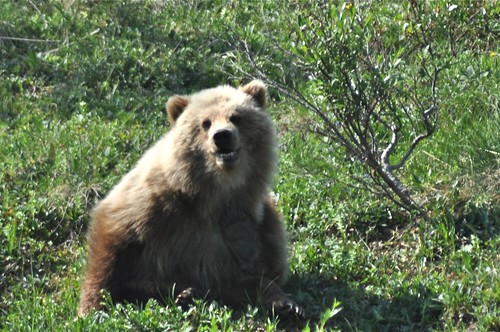 |
| Grizzly Bear in Alaska (dgrice/ Flickr) |
Moving on we saw several shrubs that seemed to be ravaged by some form of pestilence. Our driver explained that the shrubs were denuded due to the feeding frenzy of the Snowshoe Hare (Lepus americanus), which are predominant in the region. The landscape at Denali National Park is eerie on a cloudy day towards the end of summer. The mountains are stripped bare of snow, with dark patches exposed by the erosion caused by melting ice. Yet the tundra can surprise you with an occasional patch of bright red or yellow in these otherwise dreary surroundings.
Ahead we encountered Arctic Fox (Vulpus lagopus) by the side of the bus. At the Eielson Visitor Center we had to decide whether to proceed to Wonder Lake or head back to the Denali Visitor Center as the day had been rather cloudy. We chose to catch a shuttle back. We had just emerged from the visitor center when we froze. The mist was thick but we could see that the dark figure that hopped a few feet away from us was not really the cuddly kinds. We stood still as the Grizzly cub hopped towards a trail below us and were concerned that the mother might appear any moment. However, these concerns were belied as we got into the shuttle towards the Toklat River.

At the Toklat river a Grizzly foraged near the river bed. We tried to get close for a photo when a moose came calling. Not wishing to be the moose’s bunny for the day we got back to the shuttle, only to realize that the clouds were clearing.
Were we destined to catch a glimpse of Mt Denali today? We changed our minds and caught a shuttle back to the Eielson Visitor Center.
However, by the time we reached Eielson Visitor Center the weather had worsened. Disappointed, we sat before a table with the map of Alaska. Giving up hope to see Mt Denali, we decided to spend Day 2 making a foray to the Arctic Circle.
Text and photographs by Anand Yegnaswami
Other images sourced from Flickr (as credited)

