We’ve moved! Here’s where you can find us

The Green Ogre is now at https://www.greenogreindia.org
Showing posts with label Coppersmith barbet. Show all posts

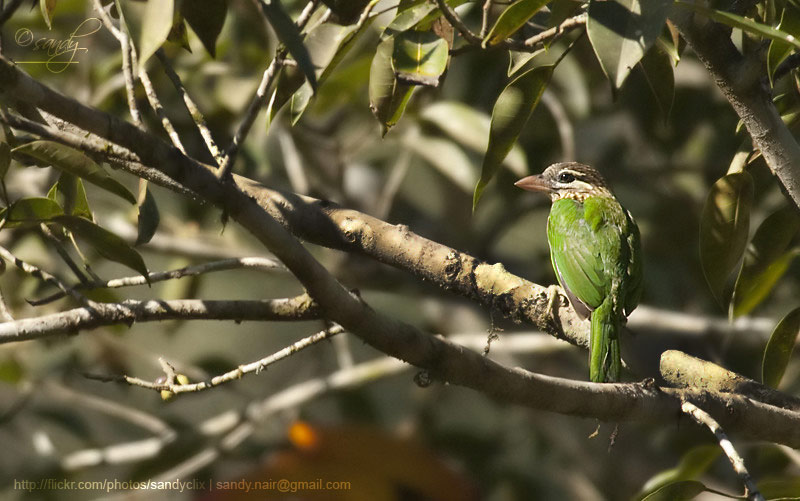
Encounter: White-cheeked Barbet, the Invisible Chatterbox

The White-cheeked Barbet, earlier known as the Small Green Barbet, just melts into the canopy. But peer into the roof of leaves and you'll see it devouring fruits and figs

I saw this green bird for the first time at Polachira, a wetland near Thiruvananthapuram. My friend Rahul pointed to a bush and said, "White cheeked Barbet". Where? All I could see were green leaves. Careful scrutiny helped me discern its form. And that was my introduction to Megalaima viridis.
In the green canopy, the barbet is tough to spot
Look carefully atop fruiting trees, and you can see through its camouflage
Unlike his cousin the Coppersmith, whom we have met earlier, the White-cheeked Barbet is not arresting in its coloration. Its body matches the green leaves, its pale pink beak almost matches the leprous trunk of a guava tree - this is a tough bird to spot when it is amidst leaves.

Oops! Hope no one saw it!
As with the Coppersmith, the White-cheeked Barbet's voice is disproportionate to its size. Go anywhere in the wooded areas of the Western Ghats and lend an ear. Above the din of forest noises you will hear a loud call from somewhere high in the canopy. "Ku-turrr, ku-turr" it goes, on and on, all day, ad nauseam. And this is undeniably in Kerala the bird answers to the name of Chinna kutturuvan -- Malayalam for 'the little one that goes kutturr'. Truly onomatopoeic!

A frugivore, the barbet uses its thick, large beak to scour out holes in tree trunks to nest. The birds are quite frequently found in orchards around the Western Ghats, launching vicious assault upon guavas, mulberries and figs. A friend once told me that they were hunted in his village with slingshots as they were a delicacy. I, though, prefer the pleasure of watching them feed and go ‘kuturrr kuturr’ any day.

Text and photos by Sandeep Somasekharan
All rights reserved

Also read Sandy's encounter with the Coppersmith Barbet

The Green Ogre Weekend Update July 31

Alaska, Gaia and birds whose presence is dwarfed by their voices -- that's what The Green Ogre was all about this week 

It's the last day of July with the monsoon still in full force over the subcontinent. In the rainforests of Agumbe, the frogs must still be calling, their trails of spawn must have hatched into little tailed tadpoles, and the snakes must be making merry at the abundance of chow. Over in Bangalore, pelicans have joined cormorants and herons in our lakes, feasting on the seasonal glut of fish. And here at The Green Ogre, we've been housebound, office-bound and our mindwalks have been extra vivid with the afterglow of unrealised dreams. The bright side: deprived of the outdoors, we sat down to write. 

Andy recalled his ramble through Alaska's Denali National Park and his encounters with moose, elk, caribou and grizzlies. In weather that was all but conducive to hiking, his friends and he flirted with the possibility of catching a glimpse of the mist-shrouded Mount Denali. Interestingly, they drove through the city of Wasilla on the same night that its former mayor and Alaska's then governor Sarah Palin was announced as John McCain's running mate in the 2008 US Presidential Election.

On Tuesday the birds came back to The Green Ogre. Recollecting a drive through his native land of Rae Bareli before the birding bug had bitten him, Sahastra described in all self-deprecation his first encounter with the Rufous-tailed Shrike. Many passers-by must have walked past the bird that day without as much as glancing at it. However, to a birder, its presence there at that time of the year was an epiphany: it was way out of its known range. Such are the serendipitous joys that await the birdwatcher, even in his or her backyard.


July 26 was the 92nd birthday of James Lovelock, who proposed the enchantingly controversial Gaia hypothesis. Offering an appreciation of the man and his work, Sahastra wrote: "Gaia as an idea has both scientific and spiritual sides. This is welcome since it helps us connect science to worldliness and makes us feel complete again. Many paint James Lovelock as a hermit scientist who never followed institutional science, has no specialization and worked in a remote corner of the British countryside rather than in a state-of-the-art lab. Lovelock said that it is precisely due to these attributes that he could think large, be moved by his own curiosity and inspiration and break the boundaries between disciplines. Eventually, inspired by the first space images of the beautiful blue planet with swirling clouds, he was able to theorize the self-regulation of Earth – true to his instinct, he called it a living earth."
Among the most commonly heard but ignored birds of our urban landscape is the Coppersmith Barbet. Its penetrating took-took call is an indelible constituent of park birdsong. Indeed, the Coppersmith's penchant for monotony makes it the heavy metal percussionist of bird songsters. How much have you seen of the little bird, though? Take a good look, for Sandy has an excellent photographic profile of this little whiskered noisemaker.

Look out for more good stuff next week. Enjoy your weekend!

Encounter: The Coppersmith Barbet


More often heard than seen, the diminutive Coppersmith is a thousand times smaller than its enormous voice

Once a while we may be treated to the sight of a coppersmith perched this low
I was on my first ever trip to Ranganathittu Bird Sanctuary near Mysore, when I had a flat tire halfway through. As I pushed my two-wheeler along with my friend for kilometers looking for a pile of tires or a board screaming "puncher" (or variants of it) advertising a puncture mechanic in these parts of the world, I saw a strikingly colorful bird on an electric line. It was predominantly dark green, with striking red tufts above the beak and under the chin. It sat there, tilting its head left and right, and then took off. And I came home, thumbed through my Salim Ali (this was before I graduated to Grimmett and Inskipp) and found the name -- Coppersmith Barbet (Megalaima haemacephala).
 
A not-so-ripe fig makes a Coppersmith look elsewhere...
I had to wait a while before I came to realize the philosophy behind the intriguing name. I came to hear (and see) it calling high up from a treetop with its neck craned -- whatever little it could manage with that short neck - and letting out a full-throated but short ringing tuk... tuk.... Apparently, this call earned the bird its name as it sounded, to the imaginative listener, like a coppersmith flattening out a sheet of his metal with a mallet.
Once his mind is set on it, no fig is too large!
Sexes are alike and juveniles are cute variants of the adults sans the red above the beak and below the eyes.
A juvenile, lacking the red crest and throat patch
The coppersmith is mostly a frugivore and a voracious fig eater -- if you see a fig tree with a large number of ripe fruits, take a closer look: the coppersmith barbet is invariably in there.
Who said three's too many?
The Coppersmith Barbet has survived in semi-urban areas and cities that offer fruiting trees for food, and cavities on tree trunks for nesting. If you still find the bird uninteresting you also might change your opinion when I tell you that it is the official bird of the city of Mumbai. That is a fitting honor for a resilient bird that is clinging on despite rampant urbanization.

Text and photographs by Sandeep Somasekharan