We’ve moved! Here’s where you can find us

The Green Ogre is now at https://www.greenogreindia.org
Showing posts with label agamid lizard. Show all posts

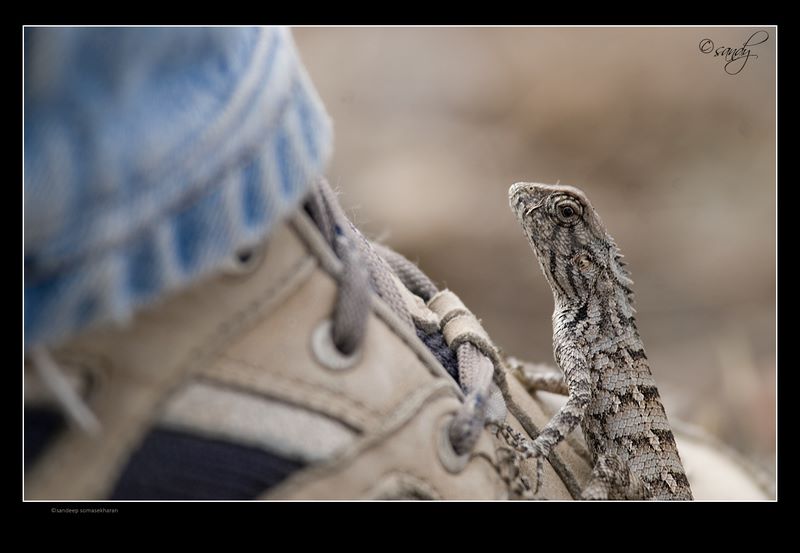
Wordless Wednesday - Don't shoe me away!


Photograph: Sandeep Somasekharan
All rights reserved
View all Wordless Wednesday posts at The Green Ogre
View Sandeep's Flickr photostream

Encounter - Elliot's Forest Lizard

When motionless, this denizen of the Western Ghats is almost impossible to spot
Can you spot the Elliot's Forest Lizard?
The nape crest and the markings are diagnostic -- look out for this guy the next time you are walking in the Western Ghats


The first time I saw the Elliot's Forest Lizard (Calotes ellioti) was on my trek to Kodachadri in Uttar Kannada district of Karnataka. I was gazing up at the canopy as usual, when a movement on a tree trunk caught my attention. When the lizard sensed my approach it did what agamid lizards do best - freeze. It relied on its wonderful camouflage for safety and did not move a muscle. This is the lizard's trick to elude predators. When motionless, this fellow is almost impossible to spot.
Blending in with the tree bark
The Elliot's Forest Lizard is common in the Western Ghats, where it is an endemic species occurring up to 6000 feet. It belongs to the family of Agamids, which comprises about 300 species found in the world's warmer regions. The Elliot's Forest Lizard is identifiable by the distinct crest on the back of the head and neck, the oblique skin fold in front of the shoulders, and an angular black mark on the side of the neck just behind the fold. Breeding males assume a darker coloration. The lizard measures about 10-12 inches from the snout to the tip of its tail.

We were unable to determine if the individual in the first picture (shot on the forest floor in Dandeli) was a female (in moult) or a juvenile. The lizard is not very shy and after "freezing" it tends to stay put. It is known to be very adaptable and, in addition to inhabiting deciduous forests, it may be found in plantations, fragmented patches and evergreen forests.

Text and Photographs by Arun Menon and Sahastrarashmi


Got a soft spot for lizards? You'd love to meet the Kashmir Rock Agama and the amazing Southern Flying Lizard.

Encounter: Kashmir Rock Agama

At 6,000 feet oxygen isn't as easy to aspire as I'd like. My lungs labour to adapt subcontinental lethargy to the punishing demands of altitude, and for a while I am oblivious to the spectacular Himalayan scenery drifting by in a sweat-soaked blur only furlongs away from my fumbling feet. As I acclimate, I feel the gentle breeze cool the sweat upon my skin, which tans slowly in the ultraviolet ray-laden sunlight.
Male (front) and female Kashmir Agamas soak up the sun


As the miasma clears, I am alerted to rustles in the grass that only reptiles can make. I hope for herpetologist's luck to chance upon Himalayan Pit Vipers, but none come my way. Sahastra and I begin our slow ascent towards Deoriya Tal from the roadhead at Sari (a village mostly uncharted except by distributors of gutkha, bottled water and kurkure) in Rudraprayag district of Uttarakhand. Minutes into our climb, we notice great fat lizards basking on the rough walls of gneiss. 


It is past nine on a warm day by Himalayan standards. But perhaps no other creature enjoys the sunshine more flamboyantly than the Kashmir Rock Agama (Laudakia tuberculata). As the rocks warm up and heat waves distort the horizon, they arrive like tourists to a beach, falling over each other as they squabble for the best spot to soak up the sun. Like all reptiles, they are "cold-blooded", in that they have limited physiological resources to maintain a constant body temperature essential for metabolism. Therefore, they depend on external sources for warmth, and the sun (now available abundantly after a protracted and wayward monsoon) is the best source of it.  


A large male at the end of the breeding season shows only the bright blue limbs
Despite not being morning persons as such, their sluggishness evaporates as they bask. Drunk on sun, they grow perky and dart energetically among the stones. Their slate-grey bodies, which offer a fitting camouflage among the blue-green chips of rock, liven up with activated pigments. When young both sexes are stippled with bright blue spots, which are replaced with patches of pigmented skin as they age. The males' forelimbs and hind-limbs darken from pale blue-gray to brilliant azure and breeding males can acquire vibrant shades of purple, yellow and orange on the flanks and throat patches. The markings on the smaller females also become accentuated during the breeding season, which lasts typically from May to August. 


Juvenile Kashmir Rock Agamas have spotted skin 
The Kashmir Rock Agama occurs commonly at lower elevations in the Western Himalayas, which includes mountainous regions in northern Punjab, Himachal Pradesh, Uttarakhand and Kashmir. Outside of India, they occur in Pakistan and Afghanistan. 


We were lucky to catch the lizards as they trooped out in large numbers from their hiding places in rock crevices to welcome the day. Some of them breakfasted on ants and small winged insects. Now and then an agama would choose a young bud or flower of the introduced Morning Glory, and make a quick meal of it. Some degree of vegetarianism has been widely documented in many agamid lizards, which are known to be omnivorous throughout the year. Breeding occurs in summer, when protein-rich insect food is widely available.


An adult makes a meal of a flower bud
As we ascended to the cool oak forest that skirts the beautiful lake of Deoriya Tal, we no longer saw the lizards. For the next two weeks our trek would take us to higher altitudes that were inhospitable for reptiles in late autumn. On our way through the foothills after our sojourn in the mountains, the Kashmir Rock Agamas were there to welcome us back. 


Text and photos by Beej
Encounter - Draco dussumieri, master of camouflage

I came across this miracle of nature towards the fag end of my supposedly "spend-time-with-family" trip to BR Hills. At the Jungle Lodges camp, I was about to return to my room after breakfast when our safari jeep driver called out to me. He pointed to something on a tree, saying it was a Southern Flying Lizard (Draco dussumieri).


Can you spot the lizard?
Well, I looked at four tree trunks over and over for a couple of minutes before I could spot it. There it sat on the tree trunk closest to me, and there was absolutely no way I would have spotted it had it not been pointed out. 


On the dull, ash-brown coloured trunk, interspersed with mottled lichen patches, I could make out a basilisk foot... As my eyes traced out the borders, I could slowly spot the other leg, the body and the tail. The head was the toughest to decipher from the background.


And now?
I changed my vantage point and tried a lateral perspective but I was amazed to find that so pressed was the lizard to the trunk that barely an outline was visible that would betray its presence. I waited to see if it would display its marvellous tree-to-tree glide, without luck. But in the end I considered myself lucky to have had such a good look at this amazing reptile!


Text and photos by Sandeep Somasekharan


Further reading:
Southern Flying Lizard on Wikipedia and the Reptile Database