We’ve moved! Here’s where you can find us

The Green Ogre is now at https://www.greenogreindia.org
Showing posts with label Golden Frog. Show all posts

The Green Ogre Weekend Update July 24

Last week the birds returned to The Green Ogre, though we have been feasting on frogs and snakes after our Agumbe conclave and continued to lick our fingers into the week that was
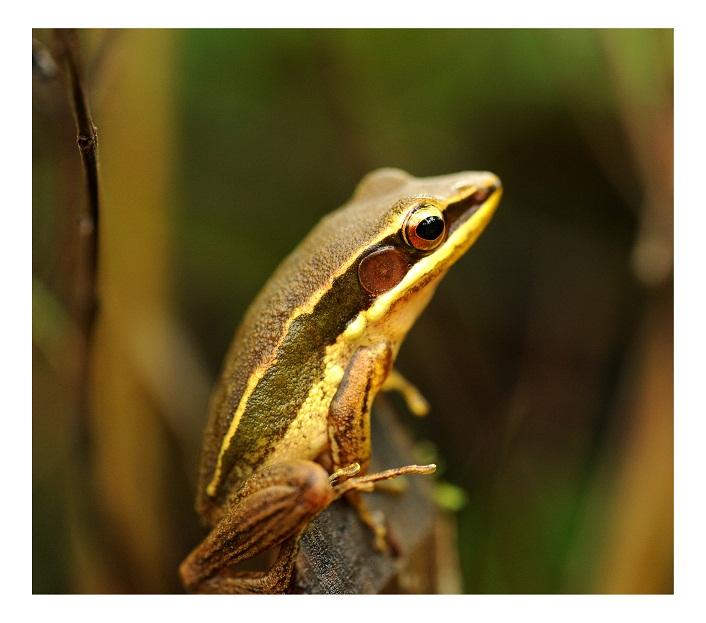
The Golden Frog
The Golden Frog (right) poses for an ardent admirer
Frogs have inspired fable, poetry and myth. And Sahastra, too. Back at Agumbe, he spent long meditative moments in the august (wasn't it June?) presence of the Golden Frog. And he came back with a lovely photo-essay on the species. Inspired by Matsuo Bashuo's immortal frog haiku, he wrote: "They were trusting, accessible and -- pardon me for anthropomorphising -- extremely friendly."
MORE >
Matsuo Basho's frog haiku (via Geishablog)
Imagine an amphibian that is frequently mistaken for a snake. In Kerala (where it is called iruthalamoori -- literally, two-headed ox) and parts of coastal Karnataka, caecilians are feared as fearsome two-headed snakes. The "heads" are in fact a pair of tentacles near the mouth, which aid the poor-sighted creature to feel its way around its dark, mulchy habitat.

Caecilian, you're breaking my heart!

At Agumbe we had the fortune of meeting the Bombay Caecilian, a purplish-black serpentine amphibian with moist, mucous-coated skin, thanks to the ARRS station manager Prashant. It was the experience of a lifetime.
MORE >


On Wednesday, the birds returned wordlessly to The Green Ogre, with Sandy showing us his picture of Racket-tailed Drongos on a monsoon date. Reminded me of that faux Japanese proverb from You Only Live Twice, quoted by Sean Connery playing 007: "Bird never make nest in bare tree."
The beautiful Nilgiri Flycatcher
In the dark, mysterious shola forests of the Nilgiris, you may chance upon a diminutive blue bird, bluer than the hills that take their name from the violet-blue blooms of Kurinji that bloom every 12 years. The Nilgiri Flycatcher is so beautiful it can make you catch your breath. As gnats and midges dance like dust motes in the cool shade of stream-watered sholas, the flycatcher hawks them with darts and sallies. Sandy regaled us with some lovely pictures. Also watch this video.
MORE >


The common Sand Boa that was saved from becoming a roadkill
Snakes are among the most common and least lamented of roadkills. And some, especially slow movers and those of nocturnal habit, are most susceptible to being run over by vehicles speeding carelessly on forest highways. Returning from a weekend trip Arun and a friend chanced upon a Common Sand Boa that was in grave risk of becoming a statistical addition to the list. "The sound that is produced as a vehicle runs over a snake is a sickening snap. I am glad I didn't have to hear it this time," he mused after they released the snake into the forest.
MORE >


Look out for more interesting posts next week. Enjoy your weekend (or what's left of it)!

Encounter: Golden Frog

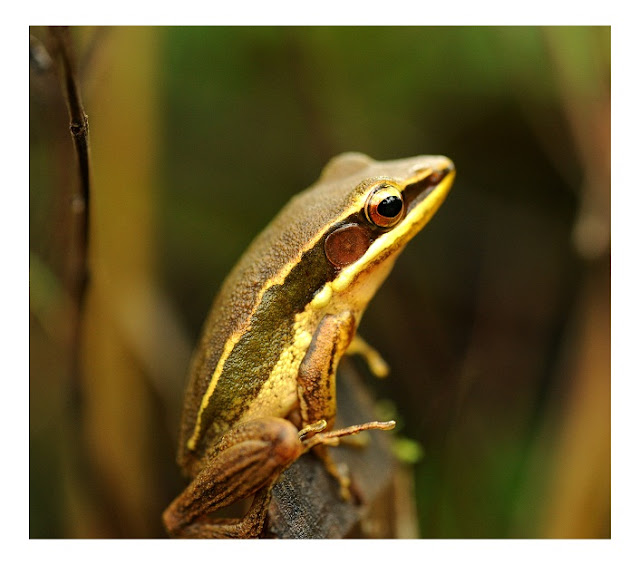
Our very own Golden Frog, a Western Ghats endemic, gave us the cherished privilege of a long and uninterrupted audience

At the outset let me state that the frog we encountered is not to be confused with the Panamanian Golden Frog (Atelopus zeteki), which was last seen and filmed in the wild in 2007. The entire known population in the wild is now assumed extinct and the frog survives only in captivity. Our Golden Frog (Hylarana aurantiaca) is luckier, but the Sword of Damocles of the amphibian world, the fungal infection chytridiomycosis, hangs over its head too.
Frogs have an extremely permeable skin, through which they can absorb oxygen into the bloodstream. Oxygen first dissolves in a thin water film on the surface of the skin and then from there into the blood. This feature, which evolved to aid their amphibious lifestyle, is now one of the reasons for the rapid decline of frog populations around the globe. The permeable skin makes them highly susceptible to toxins in the water. So evolved is this feature in frogs that a lungless frog has been discovered in 2007 in the rainforests of Borneo, Indonesia. The Bornean Flat-headed Frog (Barbourula kalimantanensis) has no lungs and this 7 cm long frog breathes entirely though its skin. The absence of lungs helps it attain a flatter body shape -- a key adaptation to survival in its habitat, fast-running mountain streams, since it aids streamlining and reduces drag. But it is already threatened due to rise in water toxicity due to mining.

We first encountered the Golden Frog during a late evening “frogging” session at ARRS. They were perched on leaves and calling (the vocal sac is internal) but in the feeble torchlight it was very difficult to make out the distinctive coloration, especially the yellow-orange back bordered by two golden streaks – the characteristics that gives them their regal name. The next day I saw a couple of them on the same bushes beside a small monsoonal wetland right outside our cottage and as the excited Ogres scanned the bushes we realized that there at least 20 of them right there. As we photographed them, the frogs maintained the calm and composure of meditating Zen monks. There was no alarm, no anxiety and no visible discomfiture. In fact, as the successive monsoon fronts arrived -- the sequence of mist, drizzle, heavy shower, sunshine, mist played out though the day -- they hardly seemed to move. I observed one of them seated in position for almost three hours. They also seemed to be quite gregarious, seated on leaves, twigs, stems and branches of the bush close to each other.

Hylarana aurantiaca is found in moist evergreen forests, swamps and coastal regions bordering the southern Western Ghats and is probably a Western Ghats endemic since the population found in Sri Lanka is suspected to belong to a separate, yet undescribed, species. It is described as a semi-arboreal and semi-aquatic frog. The frogs we came upon at the ARRS (which has a population of over 200-300 Golden Frogs) were typically perched on small bushes – on stems and twigs – and on large leaves close to the ground. There was a small disused water-logged paddyfield nearby so the bushes were technically at the edge of a shallow water body. Their IUCN status is Vulnerable.

The frog is small in size -- approximately 4 cm from the snout to the vent. The toes are dilated into discs and the middle digit of the toes is longer than the other two. It has three digits on each limb and the webbing is barely noticeable. The skin can be smooth but is often granulated especially on the back due to scattered conical tubercules. The nostril is close to the snout and the tympanum is quite distinct, almost the size of the eye, only slightly smaller.

Hylarana aurantiaca’s distinct feature is a chocolate-brown/olive-green band that runs from the tip of the snout along the flanks to the hindlegs. The eye, nostril and tympanum are all situated on this band. This band is bordered by a bright yellow, almost golden streak running all along the upper border and till the foreleg along the lower border. The back, which is essentially bordered by these two Midas-touched streaks is orange/orange-yellow or olive-brown. The back and the limbs have no barring but for some dark splotches. The eye is black and bulging, the eyelids bright orange. The underparts are creamy white and the skin is a translucent glowing orange when it is lit up by the sun.

Currently, around the world, most of the roughly 5,000 species of frogs are in decline, and we have a very real risk of losing species that are not yet discovered. In India, while 12 new species of tree-frogs were discovered by a team led by S D Biju of Delhi University, Systematics Lab, Delhi, another initiative to re-discover 50 lost amphibians of India (LOST! Amphibians of India Initiative) has yielded just five re-discoveries so far, the prized one being Chalazodes Bubble-nest Frog (Raorchestes chalazodes), unrecorded since 1874. Researchers estimate that we may have lost up to 13% of our amphibians already.

We Ogres cherish the time we spent with the Golden Frogs at ARRS. They were trusting, accessible and -- pardon me for anthropomorphising -- extremely friendly. It was a privilege to observe and photograph them from so close. The Golden Frog is a lovely representative of a species that has a special place in our hearts – be it as a Frog Prince or as a metaphor in Matsuo Basho’s famous Frog Haiku.

Text and Photographs by Sahastrarashmi
Enjoy more Agumbe Diaries