We’ve moved! Here’s where you can find us

The Green Ogre is now at https://www.greenogreindia.org
Showing posts with label bird behaviour. Show all posts

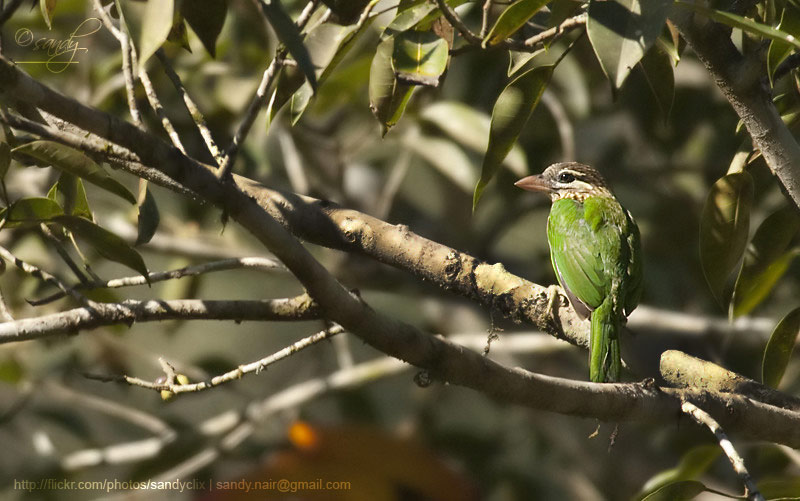
Encounter: White-cheeked Barbet, the Invisible Chatterbox

The White-cheeked Barbet, earlier known as the Small Green Barbet, just melts into the canopy. But peer into the roof of leaves and you'll see it devouring fruits and figs

I saw this green bird for the first time at Polachira, a wetland near Thiruvananthapuram. My friend Rahul pointed to a bush and said, "White cheeked Barbet". Where? All I could see were green leaves. Careful scrutiny helped me discern its form. And that was my introduction to Megalaima viridis.
In the green canopy, the barbet is tough to spot
Look carefully atop fruiting trees, and you can see through its camouflage
Unlike his cousin the Coppersmith, whom we have met earlier, the White-cheeked Barbet is not arresting in its coloration. Its body matches the green leaves, its pale pink beak almost matches the leprous trunk of a guava tree - this is a tough bird to spot when it is amidst leaves.

Oops! Hope no one saw it!
As with the Coppersmith, the White-cheeked Barbet's voice is disproportionate to its size. Go anywhere in the wooded areas of the Western Ghats and lend an ear. Above the din of forest noises you will hear a loud call from somewhere high in the canopy. "Ku-turrr, ku-turr" it goes, on and on, all day, ad nauseam. And this is undeniably in Kerala the bird answers to the name of Chinna kutturuvan -- Malayalam for 'the little one that goes kutturr'. Truly onomatopoeic!

A frugivore, the barbet uses its thick, large beak to scour out holes in tree trunks to nest. The birds are quite frequently found in orchards around the Western Ghats, launching vicious assault upon guavas, mulberries and figs. A friend once told me that they were hunted in his village with slingshots as they were a delicacy. I, though, prefer the pleasure of watching them feed and go ‘kuturrr kuturr’ any day.

Text and photos by Sandeep Somasekharan
All rights reserved

Also read Sandy's encounter with the Coppersmith Barbet

On the wing: The Racket-tailed Drongo

The spectacle of a Racket-tailed Drongo in flight can make an air-show look like a cheap circus 

The Greater Racket-tailed Drongo (Dicrurus paradiseus) is quite a character. The funky hairdo over the beak, the long-flowing tail and its ability to mimic scores of other birds makes it one very interesting chap to watch. This individual was found next to a huge congregation of birds - the only mixed flock we saw on our trip to ARRS last month. Other birds included Brown-cheeked Fulvettas, Blue-winged Parakeets and Yellow-browed Bulbuls. 


The drongo would take off from its perch on the verge of a small grassland adjoining the station campus and twist and turn in the air. It would pick up an insect or two in mid-air and alight on a branch on the other side...

Text and photo by Sandeep Somasekharan
See more posts in our On the Wing series and the Agumbe Diaries

Researchers teach birds: 'Be afraid, be very afraid'

Do all birds possess an instinct to flee predators? Or is this behaviour a result of conditioning? Research on some island birds has shown their inability to recognise mammalian predators. This may offer an explanation into how native species in island ecosystems that have evolved in the absence of mammalian predators may have hastened their extinction. Case in point: the Dodo on Mauritius. Although the bird was large and ungainly with few escape tricks, it may have also been unfamiliar with danger and this may have made it, figuratively speaking, a sitting duck for the rats and dogs and cats that arrived with the first sailors. The presence of this trait in island birds could adversely impact reintroduction programmes of threatened native bird species. Returning these birds into their predator-infested habitats is fraught with peril at the outset. 'Be afraid, be very afraid' is the survival mantra that researchers are now teaching birds. And how? By attempting to mix birds from predator-free areas with birds who know how to recognise predators in an enclosure. Researchers hope that the fearless birds would learn the fear response from their conditioned friends. PhysOrg has more Technorati Tags: , , , ,

Encounter: Malabar Whistling Thrush

Sálim Ali didn't call it the Idle Schoolboy for nothing. If, uninitiated, you hear its song in a damp nook of the forest, you may be pardoned for suspecting the presence of spirits, or maybe goat-hoofed Pan playing his merry pipes. The call is eerily like human whistling, so much that it wanders up and down the scale and has a deep, penetrating quality that carries it afar. That said, the Malabar Whistling Thrush (Myophonus horsfieldii) is more often heard than seen. To say it is shy would be an understatement. Most first-time birders are content to catch a glimpse of a dark, crow-like bird in quick, darting flight. Or perhaps skulking away into the undergrowth. But then, Luck sometimes knows how to gift-wrap a Whistling Thrush. I saw my first individual in the Nilgiris. It was perched on a low tree overhanging a stream, and pouring out its song. I have heard it several times since, most memorably one moonlit dawn in Muthodi. And then, once, we saw it briefly in BR Hills. But the best sighting of all produced this picture. Sahastra, Sunita, Sandy and I were driving through BR Hills. I was at the wheel, and we were approaching K Gudi when Sahastra hissed 'Dark bird, dark bird' from the back seat and asked me to stop. Sandy had already got his lens lined up. I switched off the engine and we coasted slowly around the bend. I braked, and the bird emerged from the shrubbery. The bird was closer than any of us have ever seen a Malabar Whistling Thrush. The blue-black spectacle was breathtaking, and behind my head I could hear Sandy clicking away. When we resumed breathing, the bird opened its pink mouth to screech, then scuttled back into the undergrowth. It wasn't a lifer for any of us, yet it was the sighting of a lifetime. Photo: © Sandeep Somasekharan. Used with permission

Birds and jailbirds - saving grace?

William Blake wrote: A Robin Redbreast in a cage Puts all Heaven in a Rage. Prisons may be a good place for conservation education to begin. And prisoners may turn out to be the most sincere conservationists. But the general public - many of whom are better off incarcerated - had better let prisoners be. The Observer has carried a very heartwarming report on two prisons in the UK - Spring Hill and Bullingdon - where prisoners have kept themselves busy fashioning nest boxes from scrap wood for the Royal Society for Protection of Birds. For conservation, where any number of volunteers is never enough, this is a vital shot in the arm Heartwarming? A lot of people don't think so. While prison authorities feel that doing good work enhances prisoners' feelings of self-worth and enable them to think of a life beyond crime, many people (obviously those who live outside prisons) want them to live the hard life and suffer for it. A sense of well being, they argue, is anathema to the idea of imprisoning wrongdoers. It's a throwback to the old argument over imprisonment itself. Time is high for activists - both human rights and animal rights - to agree on something. But the more obvious question is: Where are they when you need them?

Food crisis sets off killing spree in Guillemot colony

A shortage of fish is causing nesting guillemots to kill their neighbours' chicks. Scientists studying these hardy British birds in a colony in the Firth of Forth are anxious about an impending catastrophe.

Guillemots are highly social and huddle together in vast colonies to protect themselves against marauding gulls and jaegers that threaten their nests and chicks. However, depleting fish stocks in the North Sea are said to be the reason why the guillemots are turning on their neighbours' chicks when they are not looking. Usually, one parent stays behind at a nest when the other is out foraging. But food shortage has forced both parents to hunt, leaving the nest unattended.

How human!

More here

Technorati Tags: , , ,

The best bird photographers are ethical

KolkataBirds has compiled a very interesting showcase of the best bird photographers in India. There is a disclaimer at the bottom of the page that brushes aside all criticism or opinions one may have of this list and the methods employed to compile it. It's a bewildering list - some are unknowns, some are known schmoozers, and others merely photographers because they own some fancy equipment. But among this motley crowd are some real stars - Sudhir Shivaram, Kalyan Varma, Joanna van Gruisen - photographers whose work reveals more than posed portraits of the bird's appearance. Through their pictures they offer a revelation of rarity, of poorly known and little studied birds, as well as insight into their behaviour, habit and habitat. Dhritiman Mukherjee offers glimpses of two rarely sighted birds - the Blood Pheasant and the Himalayan Snowcock. Joanna van Gruisen's remarkable picture of a male Pheasant-tailed Jacana (the best picture of the collection) with an egg - probably not its own - in its mouth is a revelation of extraordinary and probably undocumented parental/ territorial behaviour. Kalyan Varma's wonderful picture of Wreathed Hornbills in flight offers little by way of detail but plenty in terms of behavioural insight. These are pictures worth a thousand words or more. Many of the others are just showing off their lifers. Today, photographers have better access to great equipment and many have the money and means to travel. This means that more and more shutterbugs interested in getting a great photograph and earning peer respect are travelling to forests, deserts, grasslands and other habitats on photographic safaris. What is the impact of their frequent visits on these fragile and sensitive habitats? Are their means ethical? Some of the most reputed photographers of our time were known to be absolutely callous to the plight of their photographic subjects - disturbing nesting sites, exposing nests and chicks and resorting to trickery with recorded bird calls and suchlike. With the best equipment, even a fashion photographer can photograph birds in the wild. But wildlife photographers are not merely artists and wildlife photography isn't art for art's sake. They are pilgrims in nature's great shrine, their methods are acts of prayer, and every photographic opportunity is a blessing. POSTSCRIPT: Gopi points out that Kalyan Varma's picture of the Wreathed Hornbill offers rare insight into the flocking behaviour of this species and that flocks can be quite large for a bird of this size. He also ponders the question if the increasing interest in bird photography is actually leading to increased conservation of birds - or is it just leading to more disturbed habitats.