We’ve moved! Here’s where you can find us

The Green Ogre is now at https://www.greenogreindia.org
Showing posts with label Uttar Pradesh. Show all posts

Le Question: What colour is the eye of the Sarus?

Seeing eye to eye with the Sarus Crane evokes a host of questions and the answers aren't exactly simple

Shashwat and I were driving along a small arterial road in Rae Bareli, checking out the pairs of Sarus Crane (Grus antigone) among the paddy fields on either side. It was the end of a relatively warm November day, and dusk was imminent. We came across a beautiful female near a clump of reeds by the roadside -- though sexes are almost alike, I could tell since it was smaller than the male, which was foraging a few metres away.

Me: What colour is the Sarus?
Shashwat: Grey, White.
Me: What is the colour of its face?
Shashwat: Red
Me: And the color of its beak?
Shashwat: White, Grey
Me: And the eye?
Shashwat: The Sarus has no eye!
The Sarus hadn’t lost an eye but we were looking into the setting sun with the clump of reeds and the bird in the foreground. Its bright red eye was hidden in the glowing red skin of its head -- you actually could not see it. I knew the eye existed and that he was only telling me what he saw. We were both right, as a Zen master might say, but he was in the "moment"; the unconditioned observer.
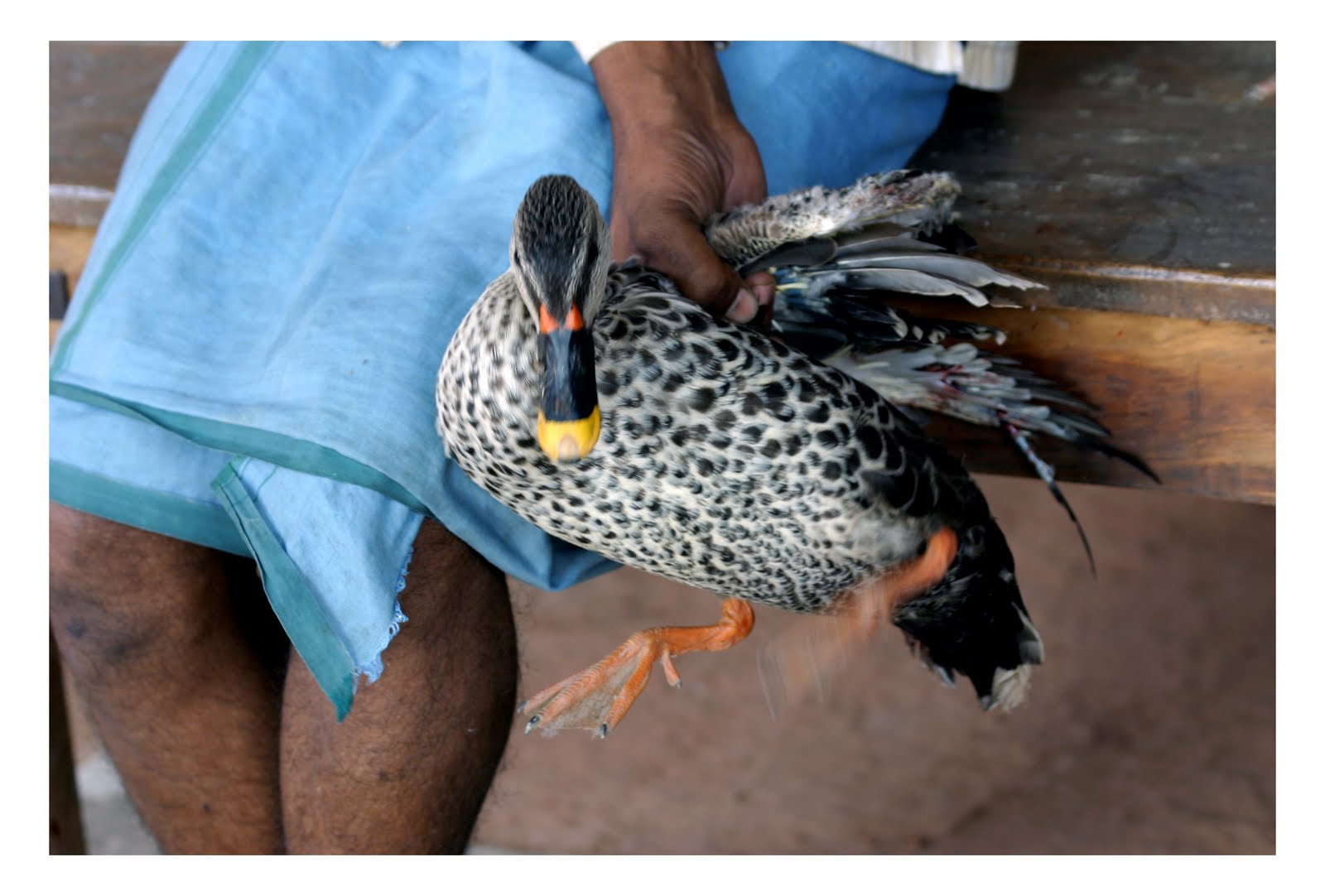
Wordless Wednesday : The Bird Trappers

A Spotbill Duck trapped for the pot in western Uttar Pradesh

Amid caged quails trapped for the pot, a girl holds a Yellow-fronted Green Pigeon


Text and photographs by Sahastrarashmi

Echoing the darkness - Water wells after the borewell revolution

As a child, they could not keep me from wells 
And old pumps with buckets and windlasses. 
I loved the dark drop, the trapped sky, the smells 
Of waterweed, fungus and dank moss. 


~ Seamus Heaney
I vividly remember the first time a bore well was dug on our fields. It involved a manual dig to locate water and then began the long and back-breaking effort to create the deep shaft, all the time praying that the initial promise of water at the site held.

Kiln Fields - How brick kilns hurt the environment

The brickmaking industry gradually converts fertile fields into sterile lands. Here's how it's done...
Sarus Cranes take flight outside a brick kiln in Uttar Pradesh's Rae Bareli district
As a kid when I used to take a bus to go outside the village, usually to Kanpur, the brick chimneys were on my list of wayside wonders. The sites were marked by huge twin maroon chimneys and they dominated the surrounding countryside. I never managed a visit any of them, but I knew they were brick kilns (or ita bhatta in the local language). I could only imagine what went on inside their huge ovens, which churned out hundreds of thousands of deep-red bricks that were used to build our houses. 


My grandfather once showed me the marking on the bricks excavated from our home – BSB. It stood for Bishwambar Nath Bhat, the owner of the brick kiln that supplied quality bricks for our home more than 100 years ago. It was the only one in the district. 


So fascinated was I by the markings on the brick that while hunting for bugs and scorpions underneath old bricks, I would observe the markings first. From just one in the district at the beginning of the twentieth century, brick kilns have now multiplied. So have their tell-tale signs – dug-out orchards, scarred fields, huge red chimneys belching smoke, chimneys under construction, fields full of clay bricks ready to be being carted to the ovens... 


Fuelled by the recent shift in economy, construction activity has boomed. New houses, shops, godowns, roads, panchayat houses, schools, hospitals and more brick kilns – everything requires them. It has become a lucrative industry. 


This is a photo-feature on the brick kilns and their impact on the surrounding environment. 


The Dug Out Orchards
Fresh land is acquired for brick kilns. Often, these are orchards with standing trees
Land is cut away around the roots of trees
This is a very common practice and a slow killer. The land surrounding the trees is cut away. The idea being that mature trees can keep producing the fruits anyway, at least for a few years after which they will collapse due to root injuries or erosion of the remaining soil. Then the orchard will be used as a regular field.
Over time, the trees die from root damage
The Scarred Fields
After the trees are gone the fields, divested of topsoil, turn fallow

Steep banks are formed by continuous water erosion
These are either the unproductive “usar” or fallow lands, usually in the village commons or bought off from farmers in need of money. The contract is for 3-5 years post which the hollowed out fields are returned to the farmers to eke out the meager and largely diminished harvests. Sometimes the soil removal is opportunistic and helps carve out fields from uneven ground. This results in steep banks where the field rat holes become nesting holes. A bank near my home is now used by swallows.
Holes in the banks can sometimes support animal life, like rats and hole-nesting birds such as swallows, hoopoes, bee-eaters and rollers
Breaking New Ground 


To keep the kilns running, new fields are obtained every few years. They are then dug upto 6 feet deep – a process that can take 3 years.
New fields are acquired to keep the kilns running
The Kiln
Enormous chimneys crown the furnaces in which the bricks are baked
The chimney is a part of the huge central semi-circular furnace surrounded by a U-shaped moat-like space, which is stacked with bricks. One batch can run for almost 6 months. The kilns are fired using local wood which, apart from topsoil consumption, constitutes the second huge impact on the local environment.
Fresh bricks are cut out from the kilns

Brick-making consumes a large quantity of firewood, taxing the local environment further
Text and Photographs by Sahastrarashmi

Agriculture and bird diversity - some findings

The winter of 08-09 has now packed away its woollies and headed off into the southern hemisphere to cool things off. But while we argued about the patterns of bird migration, the late arrival of migrants (some entirely absent) and blamed global warming for our frustrations, a biologist I know has braved the odds and conducted one of the most comprehensive bird surveys conducted in Uttar Pradesh in recent times. Streams in the agricultural landscape make excellent foraging grounds for a variety of waterbirds. The man (not in picture) is Gopi Sundar, whom readers of this blog have met virtually many times over. Gopi, as the International Crane Foundation's research associate and principal coordinator of the Indian Cranes and Wetlands Working Group, is well known for his study of Sarus cranes and their habitat in the rice-dominated agricultural landscape of Uttar Pradesh. Gopi spent the winter braving dense fog and the political mafia to execute a painstaking survey of the bird diversity in this ecosystem. He used a grid-based sampling design with space-for-time replication to test for variations in "observed patterns of bird species richness and abundance due to four different intensities of rice cultivation". His study documented 198 bird species in 160 transects. Yellow Wagtails are a relatively common species in Uttar Pradesh's cultivated areas. They are one of the last migrants to leave and can be seen feeding on insects in ripening wheat fields in early summer. Gopi's report begins with this arresting declaration: "Agriculture is the biggest threat to bird diversity worldwide." The Hindu published a report based on his work in its national edition. It opens with the very same statement. Gopi's findings suggests that agriculturists hark back to traditional land-use methods, which preserved natural habitats and enabled bird diversity. Preserving islands of natural habitat and avoiding mono-cropping or monocultures can be important steps in this direction. The Hindu report can be read here. PHOTOGRAPHS: © K. S. GOPI SUNDAR/ ICF. USED WITH PERMISSION. ALL RIGHTS RESERVED.

In Sarus Crane country, a bushel full of lifers

Between November 21 and 25, I was in Rae Bareli, a place whose name most of us remember only during the elections (it happens to be the constituency of the Gandhi family). Rae Bareli and Unnao districts are in the heart of the Gangetic plain. The countryside is characterised by flat, dusty terrain: thickets of thorn scrub and acacia, marshes and reed beds, saline mudflats, occasional orchards and a great abundance of wetlands and foodgrain cultivation - wheat, bajra, lentils, paddy, sugarcane and water chestnuts among others. The soil is a fine, powdery yellowish dust, which motor vehicles whip up into enormous clouds. Trapped in the mist, it lingers, hindering both visibility and breathing. But there is no doubt that it is fertile soil, being rich in silt washed down by the rivers. We birded every day, sometimes rising as early as 4:30 AM to be earlier than the earliest bird. Winter has set in nice and firm over northern India, and the mercury hovered around 10 degrees C on some days. We covered many of the wetlands of the districts as well as a sampling of orchards. In the reed beds and alkaline scrublands of Samaspur Bird Sanctuary, we went looking for winter arrivals. Since my trek to the Garhwal Himalayas, I have not added so many lifers on a single birding trip. Of these, our standout sightings are the Red-necked Grebe at Samaspur, the Richard's Pipit at a very disturbed wetland near Khiron and the Steppe, Imperial and Bonelli's Eagles. We got a very good look at a Red-necked Falcon, and an obliging Wryneck posed for my video camera. Among the grass stalks and reed beds, Bluethroats displayed their painted chests with aplomb. Prinias - Jungle, Plain and Graceful - joined Zitting Cisticolas and Common Stonechats in creating that ever-mellifluous marsh chorus. At Samaspur, the Striated Grassbird announced his territorial claim with a pretty little song, and much fluttering and displaying. Warblers were alive in every bush. We had a couple of excellent views of the Greater Whitethroat. Wagtails - Grey, Yellow, White and Citrine - were everywhere. And our resident White-Browed felt a little edged out, methinks. The migrant waders fed busily. There were Storks and Ibises, Little Ringed Plovers, Little and Temminck's Stints, Sandpipers (Common, Green, Marsh and Wood), flocks of Ruff, Redshanks and Greenshanks, as well as visiting White-tailed and Grey-headed Lapwings. We detoured to the banks of the Ganga at Dalmau to catch a glimpse of a handsome resident - the River Lapwing. The little guys were at their best. I had the best look I have ever had of the Red Avadavat, picking seeds off the ground only feet away from my feet. But most of all, I acquainted myself with the reigning monarch of these wetlands - the enchanting Sarus Crane. We counted (as part of a census) over a hundred Sarus cranes. This is a sentient creature - let me tell you that. No bird can inspire so much respect. Several times, as I stood watching a pair of Sarus (often less than 50 feet away), I have been struck by the dignity with which this bird carries itself. There's a certain indulgence and aloofness about the Sarus that can only come with immense power and pedigree. Mostly, they mate for life and bring up one or two chicks every year. I was lucky to see plenty of chicks - from downy, tottering ones a few days old to some that were as tall as their parents. More on that later in a separate post. Enough said. Here's the species list:
  1. Ashy Drongo
  2. Ashy Prinia
  3. Ashy-crowned Sparrow Lark
  4. Asian Barred Owlet
  5. Asian Koel
  6. Asian Openbill
  7. Bank Myna
  8. Barn Swallow
  9. Black Drongo
  10. Black Ibis
  11. Black Kite
  12. Black Redstart
  13. Black-headed Ibis
  14. Black-headed Munia
  15. Black-headed Oriole
  16. Black-shouldered Kite
  17. Black-winged Cuckooshrike
  18. Black-winged Stilt
  19. Blue Rock Pigeon
  20. Bluethroat
  21. Blue-winged Leafbird
  22. Bonelli's Eagle
  23. Booted Warbler
  24. Brahminy Starling
  25. Bronze-winged Jacana
  26. Brown Hawk Owl
  27. Brown Rock-Chat
  28. Brown-headed Barbet
  29. Cattle Egret
  30. Chestnut-bellied Nuthatch
  31. Chestnut-shouldered Petronia
  32. Chiffchaff
  33. Citrine Wagtail
  34. Common Coot
  35. Common Flameback
  36. Common Iora
  37. Common Kestrel
  38. Common Kingfisher
  39. Common Moorhen
  40. Common Myna
  41. Common Peafowl
  42. Common Pochard
  43. Common Redshank
  44. Common Sandpiper
  45. Common Stone Chat
  46. Common Tailorbird
  47. Common Teal
  48. Coppersmith Barbet
  49. Cotton Pygmy Goose
  50. Coucal
  51. Crested Lark
  52. Crested Pochard
  53. Darter
  54. Egyptian Vulture
  55. Eurasian Collared Dove
  56. Eurasian Spoonbill
  57. Gadwall
  58. Graceful Prinia
  59. Great Egret
  60. Greater Whitethroat
  61. Green Bee Eater
  62. Green Sandpiper
  63. Greenish warbler
  64. Greenshank
  65. Grey Francolin
  66. Grey Heron
  67. Grey Hornbill
  68. Grey Wagtail
  69. Grey-capped Pygmy Woodpecker
  70. Grey-headed Canary Flycatcher
  71. Grey-headed Lapwing
  72. Hoopoe (Eurasian and Indian subspecies)
  73. House Crow
  74. House Sparrow
  75. House Swift
  76. Hume's warbler
  77. Imperial Eagle
  78. Indian cormorant
  79. Indian Robin
  80. Indian Roller
  81. Indian Silverbill
  82. Intermediate Egret
  83. Jungle Babbler
  84. Jungle Prinia
  85. Large Grey Babbler
  86. Large-billed Crow
  87. Large-billed Pipit
  88. Laughing Dove
  89. Lesser Whistling Duck
  90. Lesser Whitethroat
  91. Little Egret
  92. Little Grebe
  93. Little Ringed Plover
  94. Little Stint
  95. Long-tailed Minivet
  96. Long-tailed Shrike
  97. Marsh Harrier
  98. Marsh Sandpiper
  99. Northern Shoveller
  100. Oriental Honey Buzzard
  101. Oriental Magpie-Robin
  102. Oriental Skylark
  103. Oriental White-eye
  104. Paddyfield Pipit
  105. Paddyfield Warbler
  106. Painted Stork
  107. Peregrine Falcon
  108. Pheasant-tailed Jacana
  109. Pied Bushchat
  110. Pied Kingfisher
  111. Pied Starling
  112. Plain Prinia
  113. Plum-headed Parakeet
  114. Pond Heron
  115. Purple Heron
  116. Purple Sunbird
  117. Purple Swamphen
  118. Red Avadavat
  119. Red-necked Falcon
  120. Red-necked Grebe
  121. Red-throated Flycatcher
  122. Red-vented Bulbul
  123. Red-wattled Lapwing
  124. Red-whiskered Bulbul
  125. Richard's Pipit
  126. River Lapwing
  127. Rose-ringed Parakeet
  128. Ruff
  129. Rufous Treepie
  130. Rufous-tailed Shrike
  131. Sand Lark
  132. Sarus Crane
  133. Scaly-breasted Munia
  134. Sind Sparrow
  135. Small cormorant
  136. Spotbill Duck
  137. Spotted Dove
  138. Spotted Owlet
  139. Steppe Eagle
  140. Streak-throated Weaver
  141. Striated Grassbird
  142. Tawny Pipit
  143. Temminck's Stint
  144. Verditer Flycatcher
  145. White-breasted Waterhen
  146. White-browed Wagtail
  147. White-tailed Lapwing
  148. White-throated Kingfisher
  149. Wire-tailed Swallow
  150. Wood Sandpiper
  151. Woolly-necked Stork
  152. Wryneck
  153. Yellow-crowned Woodpecker
  154. Zitting Cisticola
Videos and photos coming soon.