
Showing posts with label backyard birds. Show all posts
Showing posts with label backyard birds. Show all posts

Encounter: White-cheeked Barbet, the Invisible Chatterbox
The White-cheeked Barbet, earlier known as the Small Green Barbet, just melts into the canopy. But peer into the roof of leaves and you'll see it devouring fruits and figs
I saw this green bird for the first time at Polachira, a wetland near Thiruvananthapuram. My friend Rahul pointed to a bush and said, "White cheeked Barbet". Where? All I could see were green leaves. Careful scrutiny helped me discern its form. And that was my introduction to Megalaima viridis.
I saw this green bird for the first time at Polachira, a wetland near Thiruvananthapuram. My friend Rahul pointed to a bush and said, "White cheeked Barbet". Where? All I could see were green leaves. Careful scrutiny helped me discern its form. And that was my introduction to Megalaima viridis.
 |
| In the green canopy, the barbet is tough to spot |
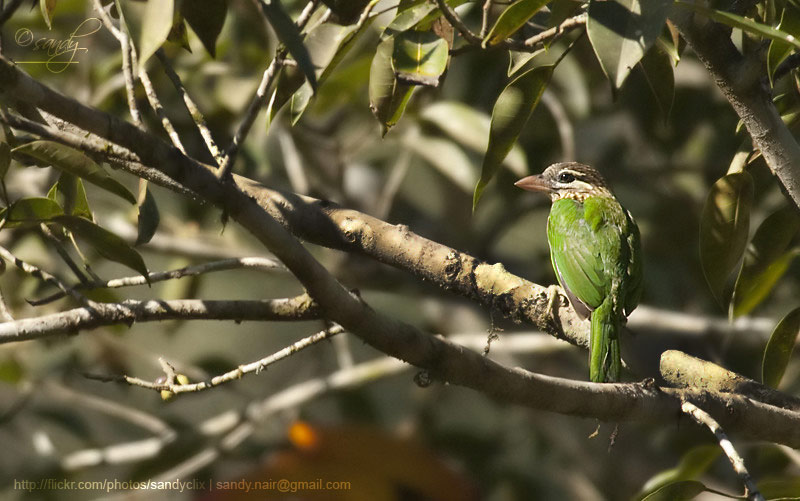 |
| Look carefully atop fruiting trees, and you can see through its camouflage |
 |
| Oops! Hope no one saw it! |
A frugivore, the barbet uses its thick, large beak to scour out holes in tree trunks to nest. The birds are quite frequently found in orchards around the Western Ghats, launching vicious assault upon guavas, mulberries and figs. A friend once told me that they were hunted in his village with slingshots as they were a delicacy. I, though, prefer the pleasure of watching them feed and go ‘kuturrr kuturr’ any day.
Text and photos by Sandeep Somasekharan
All rights reserved
Also read Sandy's encounter with the Coppersmith Barbet
Text and photos by Sandeep Somasekharan
All rights reserved
Also read Sandy's encounter with the Coppersmith Barbet
Encounter: The Coppersmith Barbet
More often heard than seen, the diminutive Coppersmith is a thousand times smaller than its enormous voice
 |
Once a while we may be treated to the sight of a coppersmith perched this low |
 |
| A not-so-ripe fig makes a Coppersmith look elsewhere... |
I had to wait a while before I came to realize the philosophy behind the intriguing name. I came to hear (and see) it calling high up from a treetop with its neck craned -- whatever little it could manage with that short neck - and letting out a full-throated but short ringing tuk... tuk.... Apparently, this call earned the bird its name as it sounded, to the imaginative listener, like a coppersmith flattening out a sheet of his metal with a mallet.
 |
Once his mind is set on it, no fig is too large! |
 |
| A juvenile, lacking the red crest and throat patch |
The coppersmith is mostly a frugivore and a voracious fig eater -- if you see a fig tree with a large number of ripe fruits, take a closer look: the coppersmith barbet is invariably in there.
 |
| Who said three's too many? |
The Coppersmith Barbet has survived in semi-urban areas and cities that offer fruiting trees for food, and cavities on tree trunks for nesting. If you still find the bird uninteresting you also might change your opinion when I tell you that it is the official bird of the city of Mumbai. That is a fitting honor for a resilient bird that is clinging on despite rampant urbanization.
Text and photographs by Sandeep Somasekharan
Subscribe to:
Comments (Atom)