We’ve moved! Here’s where you can find us

The Green Ogre is now at https://www.greenogreindia.org
Showing posts with label urban birds. Show all posts

Encounter: The Coppersmith Barbet


More often heard than seen, the diminutive Coppersmith is a thousand times smaller than its enormous voice

Once a while we may be treated to the sight of a coppersmith perched this low
I was on my first ever trip to Ranganathittu Bird Sanctuary near Mysore, when I had a flat tire halfway through. As I pushed my two-wheeler along with my friend for kilometers looking for a pile of tires or a board screaming "puncher" (or variants of it) advertising a puncture mechanic in these parts of the world, I saw a strikingly colorful bird on an electric line. It was predominantly dark green, with striking red tufts above the beak and under the chin. It sat there, tilting its head left and right, and then took off. And I came home, thumbed through my Salim Ali (this was before I graduated to Grimmett and Inskipp) and found the name -- Coppersmith Barbet (Megalaima haemacephala).
 
A not-so-ripe fig makes a Coppersmith look elsewhere...
I had to wait a while before I came to realize the philosophy behind the intriguing name. I came to hear (and see) it calling high up from a treetop with its neck craned -- whatever little it could manage with that short neck - and letting out a full-throated but short ringing tuk... tuk.... Apparently, this call earned the bird its name as it sounded, to the imaginative listener, like a coppersmith flattening out a sheet of his metal with a mallet.
Once his mind is set on it, no fig is too large!
Sexes are alike and juveniles are cute variants of the adults sans the red above the beak and below the eyes.
A juvenile, lacking the red crest and throat patch
The coppersmith is mostly a frugivore and a voracious fig eater -- if you see a fig tree with a large number of ripe fruits, take a closer look: the coppersmith barbet is invariably in there.
Who said three's too many?
The Coppersmith Barbet has survived in semi-urban areas and cities that offer fruiting trees for food, and cavities on tree trunks for nesting. If you still find the bird uninteresting you also might change your opinion when I tell you that it is the official bird of the city of Mumbai. That is a fitting honor for a resilient bird that is clinging on despite rampant urbanization.

Text and photographs by Sandeep Somasekharan

Raptor Friday - The Shikra

I have a faint memory of my grandmother telling me about a small bird that swooped down from the trees and picked up the young chickens that she reared on her little farm. She called it "eramullan" in Malayalam. I had always wondered what it might have been but I never had a chance to see it considering that my visits were brief ten-day affairs. 
An adult, probably male (from the orange eyes), stretching on its perch on an early morning
An immature, with the underside plumage showing indications of transition 
 
My first brush with the Shikra (Accipiter badius) was at Mysore. I saw it perched on the branch of a small tree at Kukkarahalli Lake. The bird also goes by other names, such as Little Banded Goshawk, Little Banded Sparrowhawk, Indian Sparrowhawk, Northern Shikra, Shikra Goshawk, etc. Though I had seen the bird in photos my first sighting was so close that I got a very good look at its hooked beak and severe-looking talons.

An adult male, clearly an older one as indicated by the red eye
An adult, probably male, in flight
Ever since I have seen the Shikra everywhere -- atop the terrace of the building next door, on electric poles, coconut trees, circling above... The flight pattern is like that of other Accipiters -- a series of quick wing-flaps followed by a glide.   

The Shikra exhibits two plumages, primarily. The young ones have brown upperparts and are heavily barred with yellow eyes. As they mature, the upperparts turn uniform slate-gray and the underside becomes heavily barred with horizontal rufous stripes. The mesial stripe becomes less distinct as the bird ages. The male, as it becomes older, develops a red iris while the female, larger in size as with most raptors, have deep yellow or yellow-orange eyes.

A fully grown female
Shikras feed on a variety of prey. I have seen them pick up winged termites immediately after the rains, chase pigeons unsuccessfully, swoop down upon Calotes lizards and -- on one occasion -- I saw it attack a grey francolin (Francolinus pondicerianus). In the last case, the francolin made a desperate attempt to get away by taking to its wings, though I couldn't see what became of the chase that ensued.

An adult, older male perched on a gate in the outskirts of Mysore 
 
Shikras are hardy birds that have managed to survive the threats of urbanization. They are found all over the varied landscape of the Indian subcontinent, except on the upper reaches of the Himalayas. 

Trivia - the Indian Navy has named one of its helicopter carriers INS Shikra. The word is derived from the Hindi "Shikara", meaning "hunter".

Text and photos by Sandeep Somasekharan

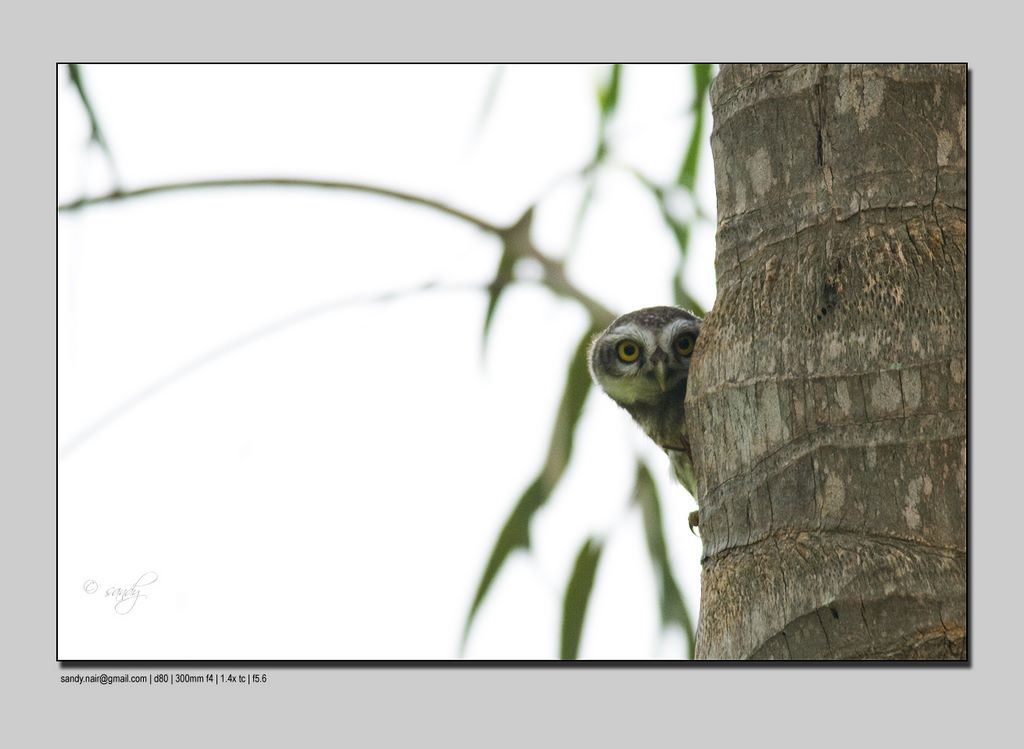
Wordless Wednesday - Spy versus spy?


Photograph: Sandeep Somasekharan