We’ve moved! Here’s where you can find us

The Green Ogre is now at https://www.greenogreindia.org
Showing posts with label garhwal. Show all posts

Odyssey to Bedni Bugyal: The trail to Wan

Distances in the Himalaya can be tricky, especially when pointed out desultorily by a guide deprived of his liquor. Thus captained, we descended the bleak slopes of Bedni toward the village of Wan. Jennifer Nandi's spellbinding Bedni Bugyal travelogue continues...
The descent from Bedni Bugyal
With our faces turned towards the new day’s maiden blush of pink, we silently bid farewell to our mountain hosts. Then we assemble for a group photograph with an imposing Trishul as a backdrop. Our faces, now bathed in daylight still driving out the dawning sky, are focused on Sahastra. We collect our rations of energy bars from him and listen politely as he tells us yet another fable – that the village of Wan is downhill until we reach a “bump” and then it’s all downhill and gradual again! What he perversely fails to reveal is that the distance to the ‘bump’ is 8 km of rocky, steep descent and that after surmounting the said ‘bump,’ the village track is not less than 4 km to the Forest Rest House at Wan. 

Sunita and I exchange knowing sidelong glances – it’s going to be a long haul.

We walk into the mist scudding over the ridge, across the frozen snarl of Himalayan roots and earth, snagging our footsteps on the charred remnants of once virile rhododendron shrubbery. Pipits and accentors lift off from our feet. We leave the bugyals behind and enter the world of laughingthrushes – a paradise for Rufous-chinned, White-throated and the Variegated. Warblers alert us with their trills. The bell-clear call of one still tantalizes us – unable as we are to identify it.

The four ponies with their caretakers rush past us, three steps to our one. We hang back leaning against soft lichen on stone to peer into an effulgence of wildness. There are Ultramarine and Rufous-gorgeted flycatchers. The undergrowth in this open weathered woodland supports thick bushes, a favoured habitat for Orange-flanked Bush Robins. Warblers abound – Western Crowned, Ashy-throated, Greenish, Large-billed, each beguiling us with its own freshness of phrase.

A spot of sun brings out the diurnal drinkers but our guide is craving his moonshine
"So, were you born and bred in a forest?" asks Satish, partly in facetiousness. The two of us, now separate from the rest of the group, are walking together. Through a curtain of leaves I saw Bijoy in a photographer’s stance and pointed him out to Satish who failed altogether to detect him. And further down the path, I singled out a Plain-backed Thrush with no wing-bars that would differentiate it from the very similar Long-tailed Thrush. Satish shakes his head with awe. My deteriorated eyesight is that of an old woman; but I guess I see well because I feel well, feel in contact with the world, and feel a healthy intoxication with whatever addresses the senses. 
Think of the accumulated wisdom in the millions of years of successful strategies honed for survival. We could learn a lot from a tree.

Satish is a trekker – companionable, and because of his frankness, elicits warmth. Sahastra roped him into the birding fraternity and the neophyte appears to have accepted his present circumstances with cheerful readiness. During each day’s trek he would spend time with us, alternating between Sunita and me, quizzing us on an eclectic range of subjects, in his inimical uncompetitive and reflective style. He has a fetching attitude to learning. Whatever his settled base of knowledge, his mind is not locked tight, impervious to new information. It is pure delight to introduce him to a kaleidoscopic world.

Strewn with leaf litter, the trail to Wan
The leaves of the conifers are greener at the tips of each branch – all ready at the very beginning of spring to photosynthesise just as soon as there is sufficient light. This energy-efficient tree does not spend precious energy each year to build all its leaves afresh. Conifers first appeared on earth some 300 million years ago and have changed little. Think of the accumulated wisdom in the millions of years of successful strategies honed for survival. We could learn a lot from a tree.

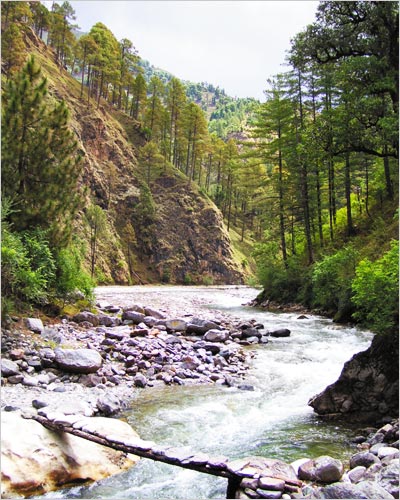
This pine, spruce and fir forest of ineffable beauty, accompanies us all the way along the stony path that drops down to meet the Bedni, when it becomes a river of more magnanimous proportions. At the bottom of the valley the river collects enough organic particles from the mountain plants growing between the boulders near its margins to acquire just enough dissolved nutrients to support animal life. Every mountain stream has its share of Plumbeous Water Redstarts and White-capped Water Redstarts making a living at a rushing river’s edge. Both species stake out a patch of water and guard it assiduously against interlopers. 

The trail meanders towards the enigmatic "bump"

A Himalayan Griffon waits for the air to warm
At the bottom of this narrow valley it has warmed sufficiently for us to jettison surplus jackets. Variations in temperature and rainfall are responsible for different ecosystems and we are welcomed by a willowy tunnel of cool shade granted gratis by riverside habitat that now includes Himalayan alder trees and Prunus cornuta. The latter is a medium-sized deciduous tree of the Rose family. Its drooping many-flowered clusters would soon become dark purple-black fruit, at first globular, but often becoming long and horn-like due to infection by insects, hence the plant’s name. But if you look closely, even the flower-clusters have assumed, in preparation perhaps, the shape of a horn.
Children immerse the idol of a deity in a stream
Sunita and I throw ourselves down on the inviting grass of the river bank scaring the Indian Tortoiseshell butterflies into sudden flight. We are tired. The stomach muscles have been working overtime to lift the weight off those stiff knees. But we are sufficiently soothed by flowering trees, birdsong, and the distinct velvet brown scent of river-bank vegetation to accept, with alacrity from Satish, the inevitable ration of ‘sattu’. However, there is an upsurge in our fortunes. He hands us each a slab of chocolate! We drink copious quantities of Electral to replenish our lost electrolytes. Devidutt throws a veil of cigarette smoke around his ration of goodies, strikes his characteristic pose and assumes an attitude of enervation. The men wash and bathe. We watch enviously as they linger in the sun-warmed water. When their clothes have baked dry, we cross the river with the right measure of reverence as one would with an animal frame of mind, mindful of black-lichened rock that could be treacherous. 

A male Plumbeous Water Redstart flirts his tail in a forest stream
At last we begin the climbing of Sahastra’s ’bump’! It begins as a hillside of ruthless depredation – open oak and rhododendron severely lopped. The hillside is hushed but for the jays that shriek their dissonance in the quiet spot. Higher up we encounter tits including the Yellow-browed, easily mistakable for a warbler but for its peaked crown. The rugged hill road flattens out across scrubland and the terraced sides of the mountains bear an emerald green. Paddy is being cultivated but 1400 years ago this was not the case as attested by the Chinese Buddhist pilgrim, Hiuen Tsang. The pilgrim had visited Garhwal in AD 634 and had described the soil as fertile and favourable to the growth of a poor kind of barley. The Garhwalis, whom he described as ‘a cheerful people, patient of fatigue,’ reared large numbers of sheep and ponies. However, since that time, the unfortunate Garhwalis have had to suffer tyrannical treatment at the hands of the invading Nepalese. From the 18th century onwards, small parties of Gorkhalis from Nepal had periodically plundered the border areas. Many thousand Garhwalis were sold as slaves during the Gorkhali occupation who ruled with a rod of iron. However, there is little sign of ruined agriculture and the lamentable decay that the Garhwali villages must have endured.


Previously in "Odyssey to Bedni Bugyal"


Odyssey to Bedni Bugyal - Loharjung to Didana

Walking in the Himalaya offers the pleasure of a constant flirtation with epiphany, learns Jennifer Nandi
A stream en route to Didana from Loharjung
A morning of magic greets us. Arrogant blue skies goad us onwards. The rugged hill road from the village leads us past an anarchy of rampant secondary growth that stretches into the valley below. This riot of plant and animal life owes its fecundity to hillsides that once supported lush forests of oak and rhododendron. Sandstone country with its covering of alluvium and glacial clays evidently suited oaks and rhododendron allowing them to grow to glorious maturity. But the oak trees were much harvested to supply the British Naval construction of the 18th century. 

Sporadic secondary growth of oak and rhododendron dot the higher hills and if you closed your eyes you could hear a Blue-capped Rock Thrush pouring out its rather monotonous undulating and fluty song. It is easily identifiable being the only rock thrush with a white patch on the wing. And if you look closely enough you can see the contrasting cobalt-blue throat. The largest of the rock thrushes, the Chestnut-bellied, is common enough, perched high up on tall trees, sometimes slowly jerking its tail up and down and on occasion uttering its softer and more subdued song.
A Blue-capped Rock Thrush showing off the 'mirrors' on its wings

Odyssey to Bedni Bugyal - Part 1

Traipsing in Lord Curzon's footsteps, we embarked for Bedni Bugyal knowing little of what to expect, and least expecting what was in store for us...


Editor's Note: In April-May 2007, six of us made a trek to the Garhwal Himalaya. Sahastrarashmi, Sunita, Jennifer, Satish, Rajeev and Bijoy walked from Loharjung to Bedni Bugyal, then descended to Wan from where we walked to Kunol and then journeyed onward to Nandprayag. For many of us it was the most intimate encounter with the beauty and power, the fury and the sagacity of the elements in the Himalayan microclimate. Jennifer Nandi wrote a penetrating account of that journey shortly afterward and shared it with us. It has been salted away in our inboxes and archives for a long time. We thought it should come out for air. Serialised over the weeks to come, Jennifer's account of the trek to Bedni Bugyal will appear on Saturdays. Make time for weekend reading. Here's part 1:
A great wall of permanently snow-capped mountains rises beyond Bedni Bugyal
Part 1 - Loharjung

Walking down the platform at Old Delhi Railway Station and trying to keep a wary eye out for the coolie burdened with my baggage, I fail to see a gesticulating hand wallop me in the face. The man shields his mouth apologetically and I smile a weak smile and walk on. I can still see, but there’s something amiss. I’m not quite sure -- until my specs fall off my face!

"Well, here’s a blind beginning to a Himalayan trek," I think, while I pull out my prescription dark glasses. On the train, none of my newly met fellow trekkers asks, “What’s with the glares at night?”

It was going to be a very long night to Kathgodam -- a reservation faux pas ensured we had one berth amongst the six of us! Sunita and I had age, gender and shamelessness on our side and so we sequester it for our sleeping space. The unearned penalty of sleeping on the floor and in linen bunkers falls to the four gentlemen! The station rears itself out and we are off. The lodestone of an adventurous attitude deeply planted within me shifts and I know that now there is no looking back.
Wheat fields en route to Loharjung
For the uninitiated, a trip into the Himalaya is merely to enumerate its thousand quirks or to act as a scribe. But the journey is always too full of diversions, digressions and distractions to merit such commonplace attention. Years of excursions into the Himalaya finely hones one’s spirit to search for yet another way of looking at the landscape. 

Where does the beauty of India reside? In the contrasts between its regions. And in the multiplicity of those regions. It was to such multiple contrasts of scenery that six of us -- Sahastra, Satish, Bijoy, Rajeev, Sunita and I -- endeavoured to climb part of the old pilgrimage route known as the Raj Jaat Yatra; the same route that King Yashdhawal’s ill-fated royal entourage with queen and nautch girls undertook over 600 years ago to the glacial shores of mysterious Roop Kund. Victor Banerjee’s award-winning film Roopkund and the Splendour of Garhwal was based on this story. A route known for its bad weather, thunder and lightning, of people perishing in cloudbursts…

Our trail would take us from Mundoli Village, across the Loharjung Pass to Didana, along the ridge of Ali Bugyal to Bedni Bugyal. On our return we would trek down to Wan and then on to Kunol, further downhill to Sitel from where we hoped to secure a vehicle to take us to Ghat and beyond to Nandprayag. We would have to make it in time to catch the train at Haridwar. 

But first, we must undertake a nine-hour gut-wrenching car journey through crowded Himalayan towns of diminished diversity. Here was a monoculture if ever there was one -- brick-and-mortar constructions built intrusively, pushing the uniformity of cement into every corner of the land where there should be rock or stone. How easy it is to obscure the character of our land by simply showing a complete disregard for the past, an ignorance of context. Are we not aware that in the fragility of a high-energy environment such as that of the Himalaya, such constructions have the shelf life of a banana!
The trail to Didana
How many of us travelling in the mountains feel compelled to be aware of the monumental history contained in the rocks? The immutable character of our country is governed by its geology, and determined by the rocks. This is an exciting notion. It means that events that happened hundreds of millions of years ago still control the lie of the land and the plants that grow on it. Those events underpin the natural history of our land – the history of the plants, animals, insects, and birds. This is the hidden landscape. Knowing this can enrich one’s awareness of our extraordinary past.

The first half of our car journey takes us through the Shivaliks; foothills formed as detritus and sediment from the rising Himalaya were deposited in a skirt at the base of the growing chain. These sediments were themselves up thrust in the last major folding event as the Indian plate pushed and ground against the Eurasian continent. This narrow skirt of the Himalaya’s own waste is about 2,000 kilometers long, forming a continuous chain. 
A blooming rhododendron beside the paved road to Wan, from which we descended into a shepherd's trail toward Didana
The now-degraded Shivaliks have an interesting ecological history. Prior to the Anglo-Sikh wars of 1845 and 1849, the hills were covered with thick acacia and pine forests. The lush tangle of undergrowth on the forest floor was home to a variety of pheasant species and deer. Crystal clear streams drained this region. Until recently, in the valley of the Ramganga in Corbett National Park it was still possible to observe species which were once fairly prevalent across the entire Shivalik belt. Thick grasslands clothed the valley floor and verdant Sal forests, the slopes. Goral could be found on the precipitous slopes, tigers in the jungles and the rivers were flush with Mahseer and the occasional Gharial.

Sadly, once the Sardars and Rajahs who owned the hunting land in the Shivaliks were evicted and the forests handed over to the villagers free of any regulatory mechanism, tree-cutting and overgrazing stripped the area. Heavy rains, poaching and a slew of ill-conceived forest policies did the rest. The loosely cemented alluvial soils of clay conglomerates were washed away. Now, under constant threat of erosion and floods, most of the Shivalik regions are a scene of dusty, rolling topography, knife-edged ridges, devoid of vegetative cover.

Northward, the Shivalik Range abuts against a 120 km wide massive mountainous tract, the Lesser Himalaya. Somewhere along the route we leave this seismic tremor and earthquake-prone foothills zone and gradually ascend the greatest concentration of mountains on earth. The topography alters. Persian Lilac and Sal give way to Horse-chestnut in full bloom. Scarlet blossoms adorn pomegranate trees and the apple has found its way here far from its ‘centre of diversity’ in the forests of Kazakhstan.
Leaving Loharjung. The meadow of Bedni Bugyal is tucked into the valley just shy of the farthest visible peak on the horizon
Late in the afternoon the car journey mounts its toll. Our empty stomachs churn and we swallow bile. We are all slightly nauseated but share aloo parathas and look for rainbows in the rain-cleared sky. If only we knew that that was going to be our last meal before we reach Didana, 24 hours later. In the GMVN room that we share in Loharjung, we rearrange luggage, pocket next morning’s ration of two energy bars each, and prepare for the trek. Sahastra, having located some super glue enroute, uses it and Bijoy’s digital dexterity to fix my spectacles for good! 

We hire four ponies to carry our baggage and a reed-thin man implores us to hire him as a guide. He is unwashed, unkempt with his meager belongings tied up in string, attached to his back. He reeks of a combination of beedi and bourbon, a local brew. Sahastra's soft heart hires him in a jiffy. The Brainfever Bird calls all night long living up to its ill-gotten name.


Photographs: Sahastrarashmi and Beej

Encounter: Chestnut-tailed Minla

Perhaps I had a karmic debt to pay the Chestnut-tailed Minla 


Battered by my first ascent of the Garhwal Himalaya, I was listening to the lament of my creaking knees en route to Kunol from Wan when Sahastra, whose knees had served him well, and Jennifer, who imbibed superpowers from yoga, decided to adventurously explore the forest in search of white-throated laughingthrushes. While I beat about the bush aimlessly, they returned triumphant. There is nothing more psychologically demolishing than being physically downbeat as your birding compadres tick away lifers. But then, I was too numbed to even bleed to Jennifer's unkind cut. 

“Did you see that?” she asked, pointing to a blur of colour in a bush that disappeared instantly. 

I shook my head. Did anyone here care about my knees? 

“It used to be called the Bar-throated Siva,” she explained as we continued walking. “Such an apt name it was. Now they've gone and renamed it.” 

Did I care? Oh, my knees! 

“What do they call it now?” asked Sahastra, whose recent sighting of the laughingthrushes had placed him in a higher league and sharpened his curiosity in the natural world. 

“Chestnut-tailed Minla,” said Jennifer, and ranted, “And no one even notices the colour of the tail.” 

Somewhere in my pain-fogged brain that name triggered a flicker of memory. But nothing came of it except a sore spot at having missed another lifer. Sahastra and Jennifer exchanged notes on the renaming and reclassification of birds, a discussion that culminated with them dousing Pam Rasmussen with buckets of vitriol. I returned to listening to the creaking of my knees. 

On my next trip to Garhwal in 2009, Sahastra and I rounded the bend beyond the hamlet of Chopta and were gazing upon the layered vista of valleys that unfolded before us from the serpentine road to Gopeshwar. Far above us, wreathed in mist, the spires of Tungnath peeped out into the sky. 

We had almost been soaked by a sudden thunderstorm the previous evening and wanted to return to our lodgings before another similar predicament befell us. Suddenly, we were stopped dead in our tracks by an enormous mixed hunting party of grey-hooded warblers, black-throated, spot-winged and green-backed tits, along with variegated laughingthrushes. Among them, one oddball bird stood out. It was nothing like any I'd ever seen. Its throat was barred, it was colourful overall and I noticed nothing of the tail except that it was long. Sahastra, too, had trouble thumbing through his mental log to identify it instantly. 

“This is that guy,” he said helpfully, “the one you missed.” 

That hit a raw nerve instantly. “I know,” I hissed, overcome by elation. A birder doesn't forget a missed encounter easily. He goes back and pores over the page listing his forgone quarry and memorises its image until it shimmers in his mind's eye with envy and desire. 

Perhaps it was the law of attraction, but the Chestnut-tailed Minla (Minla strigula) and I had finally met at the feet of Siva. What ironic coincidence!

Note: This picture was taken by Sandy on his trip with Sahastra. I couldn't join them then. Clearly, the Minla had no karmic accounts to settle with them and revealed itself happily.

Encounter: Crimson Sunbird

A chance meeting with this charming sunbird kept our spirits high through the unpredictable Himalayan weather


In September 2010, on our way to the shrine of Madhyamaheshwar, we spent a night at the beautifully situated GMVN guest house at Ukhimath. It had been a year of catastrophic rains – an extremely heavy and extended monsoon had wreaked havoc on the roads and the landslides continued to pile up as more rain was forecast.


As we stood contemplating the ominous news that we had just received -- a part of the road leading to the starting point of our trek at the village of Uniana had been washed off -- we picked up a sunbird-like call from a bottle-brush tree beside the bungalow. 

Could it be the Green-tailed Sunbird? I had seen it at Chopta (2,900m) but this (at 1,130 m) seemed a tad low for either the Green-tailed or the Fire-tailed Sunbird. But it was also high for the ubiquitous Purple Sunbird that is so common in the plains. As we stepped out to scan the tree, we spied the unmistakable scarlet breast that glowed as if on fire in the rays of the morning sun. It was the Crimson Sunbird (Aethopyga siparaja).

Though this sunbird is fairly common (it is found in the Western Himalayas, Sahyadris, and a race occurs in the Nicobar Islands), this was my first sighting. The bird was quite restless and kept flitting from the bottle brush tree to a large dense-canopied tree nearby. It made these sorties while vocalizing all the time. 

The bird has a crimson patch on the mantle and a yellow spot just above the rump but from the view that we had, the scarlet breast and throat merged into a rather drab grey-olive belly. The tail is greenish and much longer than that of the Small Sunbird or Crimson-backed sunbird (Nectarinia minima) which also has a much less curved beak. The Crimson Sunbird is supposed to have a preference for red flowers which may have been the reason for its multiple sorties to the bottlebrush, a plant introduced from Australia. It’s also a favorite of the Purple Sunbird (Nectarinia asiatica).

Pretty soon the staff of the guest house got interested and took turns gazing at the beauty – which was present at Ukhimath year-round but which they had probably never looked at so closely. Beaming with pride at our joy of a lifer, they said: “Uttarakhand mein aapko bahut sundar pakshi dikhenge” (you will see very beautiful birds in Uttarakhand). We knew they were right and in the days ahead their lighthearted quip kept our hopes high as we we negotiated blocked roads, incessant rains and imminent landslides to bird persistently in the Himalaya.

The Crimson Sunbird is the unofficial national bird of Singapore.

In the arms of Shiva - a trek to Tungnath

Tungnath
Only the peal of temple bells punctuates the stillness of the mountain air


This travelogue on my trek to Tungnath, the highest Shiva shrine in the world, has appeared as an India Abroad Magazine cover story with the dateline December 4, 2009.

India Abroad
, owned by Rediff.com and published chiefly from New York, is the oldest and most widely read community newspaper among Indian-Americans in the United States.

To subscribe, or to order a copy or a back issue, please visit the India Abroad web page


In the arms of Shiva


Off National Highway 58 at Rudraprayag, about a mile’s drive from the uproarious junction of two mountain rivers in the Garhwal Himalayas, stands an unimposing walled garden planted with crotons and overgrown with invasive weeds. At its center a white concrete plaque unceremoniously marks the spot where an Indian-born hunter of Irish descent shot a leopard in 1926. Beside it, a signboard in the green-and-red flag colors of the Uttarakhand forest department informs us that this was no ordinary animal: the cat had haunted the valley for eight years and claimed 125 human lives.


A man-eating leopard in these unrepentant urban environs? I imagine a shadowy creature, dappled with rosettes, stalking me. It’s pointless: the growl I hear emanates from multi-utility vehicles zipping on the macadam behind me.


In the 1920s, long before the muddy glare of sodium-vapor lighting and the glowering beacons of wireless towers had confounded Mother Nature’s circadian rhythm, the Himalayan night must have offered more grist for the imagination. Under starlight, fancy eloped with fact and spawned many myths around the beast. But this much we know to be true: villagers refused to step out of their homes after sundown for fear of being the leopard’s next quarry. And that was bad news for Rudraprayag, an important halt on the routes to the sacred Hindu temples of Kedarnath and Badrinath.


When the British government in India announced a reward for killing the man-eater, bounty hunters turned in many leopards claiming each one to be the culprit. Meanwhile, the death toll mounted. In desperation the British Parliament turned to Edward James Corbett, a railway contractor and a crack shot who lived in Nainital in the adjoining Kumaon region. Jim Corbett accepted the offer on two conditions: that all rewards for killing the leopard be withdrawn, and that other hunters trailing the cat be ordered to stop. In his gripping memoir The Man-eating Leopard of Rudraprayag, Corbett chronicles his dramatic two-year pursuit of the big cat before he gunned it down at this very spot.


Every year a fair is held to commemorate Corbett’s achievement and some village elders cling to the belief that this specialist hunter of man-eaters and pioneer conservationist (India’s largest national park, the Corbett Tiger Reserve, is named after him) was a holy man sent to rid them of an evil spirit. The younger generation, however, seems to have grown unmindful of this aspect of the town’s history. My friend Sahas had to instruct our driver, a road-raging boor, to slow down lest he missed the memorial.


~~~


himalayan griffon silhouette
A Himalayan Griffon vulture soars above the temple of Tungnath. In his book Sacred Waters: A Pilgrimage to the Many Sources of the Ganga, Stephen Alter invokes a legend that deems the vultures as one of the first beings of the primordial world. The vulture's egg represents the world - its upper dome the sky and its lower dome the earth; the watery fluid the oceans and the yolk the land.

Rudraprayag is today the headquarters of an eponymous district in the Tehri-Garhwal region of the northern Indian state of Uttarakhand. At 4 pm, it is hot and stuffy in the marketplace and the air is rank with diesel fumes. Flies flirt with my eyelashes and nostrils. At the drugstore where I stop to stock our first-aid kit, the teenage shopkeeper does not lift his eyes up from the playlist he is shuffling on his cell phone. Nearby, overflowing rubbish bins invite dogs and donkeys to rummage for surprises.


My delusion of the Corbettian Himalayan hamlet has evaporated and found a place alongside other disappointments – fetid gutters gurgling beside the highway, deforested landslide-scarred slopes crowned with modern temples the color of unappetizing confectionery, and hummocks of garbage and polythene bags where crows and kites bicker over morsels.


Yet, in other ways, Father Time has not grayed for the last thirty years. Tacked to the pillar of a wayside temple, a Garhwali film poster for Meru Gau [My Village] has artwork redolent of an age bygone when Indian cinema was besotted with nationalism. Vendors hawk vegetables and fruit on wooden carts, shooing away wandering cows that pause to inspect their wares. In a sooty teashop, a hirsute cook in a grimy sleeveless vest rolls parathas while his slick-haired apprentice shapes dough into cones, tucking a dollop of spiced potato into the hollow of each one. Sealing the ends, he drops his finished creations delicately into an enormous wok of sizzling oil that browns them into crisp samosas.


Three ceiling fans spin giddily inside the dormitory of the Rudra Guest House run by the Garhwal Mandal Vikas Nigam, a government-owned tourism agency that offers reliable budget accommodation. From its courtyard I take in an unbroken view of the gorge about a hundred feet below, where the deep-green Mandakini (which rises near Kedarnath) is consumed by the foamy wake of the silt-laden Alakananda, a major headstream of the Ganga that springs near Badrinath.


Washed by the sacred waters of two streams of faith, Rudraprayag is the fourth of the five sacred prayags, or confluences, of the Gangetic riverine system in the Himalayas. Forty-two miles southwest, at the final confluence in Devprayag, the Alakananda joins the clear waters of the Bhagirathi, the source stream of the Ganga which has flowed 435 miles from Gaumukh at the lip of the Gangotri glacier.


From Rudraprayag, our bus crosses the Mandakini and takes us 25 miles to Ukhimath, a village of terraced rice fields 4,500 feet above sea level. In October, before autumnal snowfall makes the trail to Kedarnath unwalkable, the deity is brought down in a ceremonial palanquin to the Omkareshwar Pith temple at Ukhimath and worshipped here till it is returned to the mountain shrine in mid-May. Another Shiva idol, from the shrine at Madhyamaheshwar, is also housed here in winter. Both Kedarnath and Madhyamaheshwar are among the five sacred Shiva shrines known collectively as the Panch Kedar (the Five Kedars – Kedar being a local name for Shiva). The others are Tungnath, Kalpeshwar and Rudranath.


Legend holds that the Pandavas, protagonists of the Hindu epic Mahabharata, having decimated their cousins the Kauravas in the great war at Kurukshetra, wished to atone for the sin of fratricide. They arrived in the Himalayas to seek Shiva’s blessings but the Lord, disgusted with the horror of war, changed form into a bull to avoid them. His pursuers saw through his disguise and gave chase. In the scuffle, the bull was dismembered. Its body parts reappeared in various regions of the Himalayas – the hump at Kedarnath, the arms at Tungnath, the face at Rudranath, the navel at Madhyamaheshwar and the locks at Kalpeshwar. The head, it is believed, emerged at the Pashupatinath temple in Kathmandu, Nepal. Pilgrims consider a circuit of these shrines to be auspicious.


Our destination is Tungnath, the third Kedar, and my purpose is religious only in a pagan sense. To walk the wild Himalayas, breathe their bounteous air, encounter their wildlife, their trees and wildflowers, rivers and springs, and to be at the mercy of their elements is pilgrimage enough for us.


The timing of our trip is significant. In late September, the monsoon gathers its weakening winds to drench the Himalayas in a final burst of rain. Last November, I followed the monsoon on its return journey through the southern hills of Tamil Nadu (Chasing the Other Monsoon, India Abroad Magazine, May 1, 2009) and now, I am here to witness the spectacle of its retreat from the Himalayas.


Encounter: Russet Sparrow

Like thousands of coins jingling in hundreds of fists, the chirruping of sparrows heralds dusk. Trees quiver as roosting flocks fuss like train passengers arguing over berths. The din dies down with the fading light and all is quiet again. Until the morning, when breakfast squabbles are made public and flocks prepare to go about their business foraging around homesteads, fields and forest clearings. Few people give sparrows a second look, but the first glance itself evokes tender smiles because nearly everybody has observed the disappearance of House Sparrows from cities. However, they are still up and about in villages where old-fashioned houses offer them the shelter of eaves and awnings and their pastoral environs an ample supply of food. In the Himalaya, though, it may serve us well to keep our eyes peeled for the Russet Sparrow (Passer rutilans cinnamomeus). Its call is similar to the House Sparrow's, but males in breeding plumage are easy to tell by their rich cinnamon crowns and backs. For this reason, it was earlier called the Cinnamon Sparrow (a much more evocative name, in my humble but effete opinion). This male (in winter plumage) was photographed at the Garhwal Mandal Vikas Nigam guest house in Ukhimath, Uttarakhand among a flock of House Sparrows (Passer domesticus). The House Sparrows, of course, were busy making their tribe increase. Which raised the following questions: a) Do the two species interbreed where their ranges overlap? b) Do House Sparrows breed year round while Russet Sparrows have a fixed breeding season? Someone in the know might be able to tell me. Photographs © Bijoy Venugopal. All rights reserved.

Garhwal, April - May 2007

Six birders - some green, some brown, others a primed yellow - made a trek to the Garhwal Himalaya in April 2007. I, who used to consider myself one of the primed yellow category, found myself so clueless at times that I became a birder of many colours. An account of that trek - as a travel piece, not a birding trip - has been published on Rediff.com (first in India Abroad's travel special). Here is the link

Himalaya on my mind


If my piece on the Bedni Bugyal trek was a one-week breeze, here comes the hurricane.

My good friend Jennifer Nandi, whose reading has ingrained in her the poesy of Thoreau and the acidity of Dame Dorothy Parker, has written what I believe to be a heartfelt and insightful account of the trek of which we were both a part.

It was perhaps relevant that I met Jennifer for the first time on this journey, and that I met her in an age of data - where we wage impatient battles with an arsenal of information but little understanding. I found in her approach to understanding nature a sense of what I'd like my children to inherit from me - an insatiable curiosity about the machinations of the natural world life, the zeal to communicate it to those who probably do not care, and a never-say-dieness about getting it done.

Read her account.