We’ve moved! Here’s where you can find us

The Green Ogre is now at https://www.greenogreindia.org
Showing posts with label river. Show all posts

Odyssey to Bedni Bugyal - Loharjung to Didana

Walking in the Himalaya offers the pleasure of a constant flirtation with epiphany, learns Jennifer Nandi
A stream en route to Didana from Loharjung
A morning of magic greets us. Arrogant blue skies goad us onwards. The rugged hill road from the village leads us past an anarchy of rampant secondary growth that stretches into the valley below. This riot of plant and animal life owes its fecundity to hillsides that once supported lush forests of oak and rhododendron. Sandstone country with its covering of alluvium and glacial clays evidently suited oaks and rhododendron allowing them to grow to glorious maturity. But the oak trees were much harvested to supply the British Naval construction of the 18th century. 

Sporadic secondary growth of oak and rhododendron dot the higher hills and if you closed your eyes you could hear a Blue-capped Rock Thrush pouring out its rather monotonous undulating and fluty song. It is easily identifiable being the only rock thrush with a white patch on the wing. And if you look closely enough you can see the contrasting cobalt-blue throat. The largest of the rock thrushes, the Chestnut-bellied, is common enough, perched high up on tall trees, sometimes slowly jerking its tail up and down and on occasion uttering its softer and more subdued song.
A Blue-capped Rock Thrush showing off the 'mirrors' on its wings

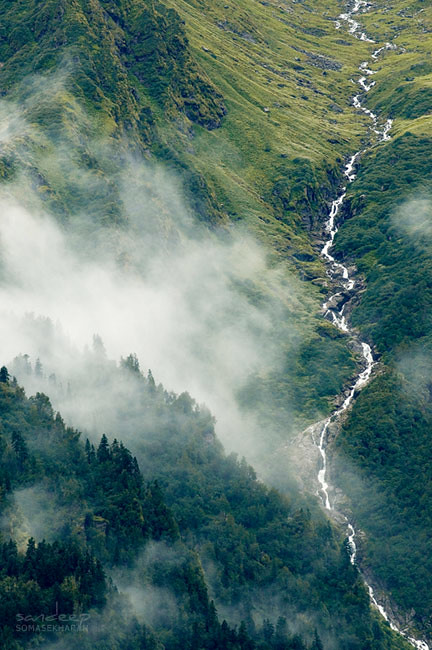
Wordless Wednesday: A Himalayan Riverscape


Photograph: Sandeep Somasekharan
All rights reserved

Pichavaram - the great mangrove forest of Tamil Nadu

Few people know (or care) that this favourite locale of filmmakers is a spectacular mangrove ecosystem throbbing with life
The mangrove forests of Pichavaram comprise an intriguing ecosystem

Tickets in hand, negotiations with the boatman closed, we should have been on the boat, headed for our first visit to a mangrove ecosystem. But all we could do was to gaze longingly at the dense green clumps across a vast expanse of the lagoon. The boat that was to carry us there was moored to the shore covered in blue tarpaulin. A sudden squall was depositing even more rain on the already soaked and overflowing coastline of southern Tamil Nadu and we were right in the centre of it all – at the northern edge of the Cauvery delta. 


A sudden squall threatened to drown out our much-awaited trip

Pichavaram, one of only two mangrove ecosystems located in Tamil Nadu, is approximately 75 km south of Pondicherry and 15 km from the temple town of Chidambaram. We had reached Pichavaram in the afternoon after a very enriching visit to the great living Chola temple. To be fair, the day had been fairly dry but now that we had planned to be on open water for the next four hours, it had started pouring.


Our entry into the mangroves began with the boatman negotiating one of the tamer channels
The Cauvery delta is formed when the river breaks up into multiple distributaries after Srirangam island. The northernmost distributary Coleroon (or Killidam) meets the sea near Pichavaram (the other river that drains this area is Vellar and the wetland is referred to as Vellar-Pichavaram-Coleroon wetland). The other mangrove patch is at Muthupet, which happens to be at the southernmost point of the Cauvery delta; the distance between the two is 180 km. Muthupet has a large lagoon where six distributaries discharge their waters. These mangroves are characterized by a long dry season (February to September) and high salinity.
Inside the mangroves
The shower stopped as suddenly as it had begun. We were off in a jiffy, the boatman rowing slowly and steadily across to the mangroves. Clouds streamed in from the ocean, promising more rain, but we pretended not to care. Pichavaram has almost 4,000 rivulets of varying length and width with mangroves on either side. As we entered the first, not more than six feet across, we saw the mangroves up close. They seem to grow out of water (there is not a patch of ground visible anywhere) almost like a floating forest.
The canopy weaves a tangled web, and not always a friendly one

The boatman was accomplished at clearing our way
As the boat negotiated the first turn, to our utter amazement and delight we entered a long and narrow rivulet completely wrapped in mangroves. It was like entering a green tunnel – the boatman had to row by moving the low, tangled mangrove branches out of the way. The banks of the rivulet were covered with mangrove roots reaching into the water – hundreds for every clump. The sky was swallowed up completely by the arches of these low trees and all we could see was the narrow rivulet and a vast impenetrable forest growing out of turbid water. The world had dissolved into an expanse of brown and red stilt roots (and all the shades in between) and the luxuriant green foliage of the mangroves, upon which streaks of sunlight created an impressionist canvas of rust, brown, olive, jade, lime-green and emerald.


A maze of stilt roots

In the eerie silence, as we negotiated one tunnel after another, crabs lit up the scene. They were everywhere – climbing up from the water’s edge, clinging to the trunks, hanging on to the canopy and perched in silence on overarching branches. A myriad species of crabs inhabit the forest and it was unfortunate that we knew so little about them. Soon enough we entered one of the wider channels. It was almost 100 feet across, like highways connecting the islands of mangroves. Forest towered on either side, dense and glistening in the evening sun.

The low boughs were the province of a myriad species of crabs
The east coast wetlands starting from the Sundarbans right down to Pichavaram (and Muthupet) receive a major infusion of fresh water from the rivers either throughout the year (the snow-fed Ganga and Brahmaputra) or during the northeast monsoon (Krishna, Godavari and Cauvery). Salinity levels vary through the season in proportion to the fresh water discharge but the trend is towards an increase in salinity as we move down the coast. So, while the Sundarbans have the least salinity (and the shortest dry season), the mangrove wetlands of the Cauvery delta have the maximum salinity levels and the longest dry season. Salinity (or the absence of freshwater intake) has an observed impact on biomass and species diversity. The Sunderbans and Mahanadi mangroves have 26 recorded mangrove species (out of the 33 found in India, 51 in South Asia and 68 worldwide), and high biomass due to tall low-salinity tolerant trees. But the mangrove species diversity drops to 17 for Godavari, 12 for Krishna and finally 11 for Cauvery. 


The sea-water dominated mangroves of Gujarat (with almost no fresh water infusion) have a species diversity of just eight. Further, the dominant species in all the high salinity mangroves -- those of the rivers Cauvery and Krishna and in Gujarat -- is Avicennia marina, an extremely saline water-tolerant species.

It has been observed that except in Andaman and Nicobar Islands, where the mangroves along tidal creeks, lagoons and bays are extremely diverse, those of the east coast are gradually being dominated by high salt-tolerant species like Avicennia marina due to changes in quantity and periodicity of fresh water. It has been found that the vegetation of Pichavaram and Muthupet wetlands used to be more diverse in the beginning of the 20th century but since the freshwater inflow was severely curtailed by the numerous dams and canals upstream on the Cauvery, Avicennia marina became dominant.


Mangroves receive an infusion of river water during the monsoon

We spent almost three hours in this verdant forest. It was a strangely hypnotic world. The dense forest growing out of the water, trees on stilts, and meditating crabs perched where we expected birds, puzzled our senses. But it was a real world, a shrinking and vulnerable patch of forest, and probably the last remnant of the much vaster mangrove forests that occupied the Cauvery Delta.


A strangely hypnotic world
Note:
Mangrove wetlands in India are in most cases the gift of east-flowing rivers. Other than the geological fact that India has no major west-flowing rivers, the east coast is gentler and wider and thus aids major rivers in creating large deltas and an accompanying network of tidal creeks and canals, and brackish lagoons where the mangroves thrive.

The major mangroves patches in India are Sunderbans (Ganga-Brahmaputra), Mahanadi (Mahanadi, Brahmini and Baitarani – the famous Bhitarkanika wetland), Godavari (the Gautami-Godavari system creates the Coringa wetland), Krishna (three islands located between Gollamattapaya and Nadimeru distributaries, and the Krishna river) and Cauvery (Pichavaram and Muthupet). The river dominated (tide-dominated in the case of the Sunderbans) mangroves of the east coast comprise approx 57 percent of India’s mangroves.

The west coast mangroves, all of which are in Gujarat (Gulf of Kutch and the Gulf of Khambat), comprise about 23 percent and those of Andaman and Nicobar Islands make up the remaining 20 percent. There are no statistically significant mangroves outside these five states (Andhra Pradesh, Tamil Nadu, Odisha, West Bengal and Gujarat) and Andaman and Nicobar islands, though small patches exist along the coasts of Kerala, Karnataka, Maharashtra and Goa.


We saw very few birds inside the forests but for the Striated Heron or the Mangrove Heron
The Gujarat mangroves are of a very different type. They are “sea mangroves” since they receive almost no freshwater from inland rivers during the year. These are classified as “drowned-valley type mangroves”.

Text and photographs by Sahastrarashmi
Additional photographs by Bijoy Venugopal


References: 


V Selvam, Environmental Classification of Mangrove Wetlands of India [PDF]

Birds of the Varanasi River Front - a photo-essay

Sparrows on the wood weighing scale
Sparrows dust-bathing in a boat
A Blue Rock Pigeon drinks of its reflection
A White-throated Kingfisher brightens the clutter
Bank Mynas inspect a priest's wares
A Bank Myna surveys its domain
Even paradise takes prisoners, like this parakeet
Monkey business as usual - and does the kite qualify as a bird?


All of us at The Green Ogre wish you a very happy 2011, filled with hope for the future of our earth.


Photographs by Sahastrarashmi

Encounter: Brown Headed Gulls in the City of Light


One does not usually associate birding with Varanasi’s riverfront. This ancient and holy city, which is amongst the oldest continuously inhabited places on earth, is crowded, filthy, crassly commercial, oozes religiosity, garishly dressed up, loud, endlessly fascinating, photogenic, friendly, unpretentious and very often sublimely beautiful -- even spiritual. Bird life is limited to the commoners – Bank Mynas, Rock Pigeons, Black Kites, Rose-ringed Parakeets (both free and caged), Common Crows, Sparrows, an occasional Pond Heron, White-thoated Kingfishers (and sometimes it’s Pied cousin), Wagtails (a few Grey Wagtails in the winters) and an occasional Magpie Robin. The river front is over built and the entire 6 km long curve of the Ganga is choked with ghats, steps, temples, teashops and people. Successive generations of preachers and princes have all strived to leave behind a legacy and ghats are the scene of round-the-clock outpouring of humanity and its rituals. The entire spectrum of life’s chores, from deep meditation to sewage disposal, are carried out with the same fervour.

However, in winter this city is host to a beautiful migrant – the Brown-headed Gull (Larus brunnicephalus). On chilly and calm mornings, as the fog reluctantly rises above the languid river and the boats disgorge the lighted diyas on the frigid waters, one can notice skeins of dim white birds doing low passes on the river’s surface. Soon enough, as the day warms and visibility improves the cries of “aaaao – aaaao” are heard from the ghat steps and the boats. The gulls recognize it, in fact are waiting for it. They mob the source of the sound - boats in midriver, bathers on the banks and regular bird feeders – all are distributing food and a feeding orgy ensues. Residents love the birds for they break the monotony of the riverscape which has few waterbirds if any at all. The tourists are pleasantly surprised at this unexpected bounty from nature in a city where their purpose is mostly religious. Those who feed birds regularly at dawn and dusk relish this novel punya and for once the pigeons, monkeys and the sparrows take a backseat. The food offered to the birds is mostly fried savouries (namkeen), which are by no means suitable but the gulls seem to relish and fall over each other to get to the salty morsels. They are fed all through the day, every boat with tourists wants to experience this thrill and the fish and the turtles (introduced to help clean this stretch of Ganga, which carries a more than normal share of bio-waste) are the lucky beneficiaries of this largesse. The demand for gull feed has led to a seasonal occupation – a few boats in the river are there for the sole purpose of selling “bird namkeen” to the boaters and the enterprising boatmen advertise their wares by calling out “aaaao – aaaao”, getting the birds to fly in but hold back the food. The Brown-headed Gull breeds in the marshes and bogs of the Central Asian plateau and high-altitude lakes of Ladakh in India (among them Pangong Tso). It nests on the ground (usually a mound of grass on marshy terrain) in large colonies and is a gregarious species. It is migratory, wintering on the coasts, tidal creeks and large inland lakes of tropical southern Asia. In India it is found along the coasts, large lakes and river systems of northern India. I have seen it on the Ganga-Yamuna river system at several locations including the confluence (Sangam) at Allahabad. While wintering they often flock with other gulls and terns and we have seen them in large flocks with Caspian (Hydroprogne caspia, formerly Sterna caspia) , Greater Crested (Sterna bergii) and Lesser Crested terns (Sterna bengalensis), on a coastal sand bar near Marakkanam in Tamil Nadu (November 2010). It is a bold and opportunistic feeder. It scavenges and also eats small invertebrates and winged quarry. The dark brown hood is seen only in breeding plumage. In winter plumage, the head is white with a prominent dark spot behind the eye. The bill is dark red with a black tip. The legs are red and the eyes are white. It has a grey upper wing and broad white primary base, creating white half-moon against black wing-tip with prominent white mirrors (a diagnostic help). The tail is white and quite prominent in flight.
The residents love the birds and it is with a sense of pride that they tell the Indian tourists about this “safed kaowa” from Siberia (literally white crows) which is a regular visitor to the holy city. Bizarre as it may seem, this appellation is not such a farfetched one – for the gulls are numerous, mob the feeders like crows do, and for once they outnumber the crows ten to one. This is the only urban landscape where there are fewer crows than gulls or for that matter any other species of birds (mynas included). Text and photographs by Sahastrarashmi

Valley of Potpourri - Autumn in the Valley of Flowers


In late September last year, I joined Sahastra and a group of four friends on a trek to the Valley of Flowers in Uttarakhand. When we reached there we were told that the season for flowers had slipped behind us by two weeks. We prepared for disappointment but instead discovered to our happy surprise that the Valley in September was fall's magical fairyland, ready to be tucked in for a long winter nap. This piece was published as the cover story in India Abroad Magazine, August 27, 2010.  


Autumn burnishes the Valley of Flowers with ochre, gold and fawn
WHEN I ARRIVED in the Valley of Flowers, Uttarakhand, I expected to experience the vistas I had gleaned from brochures and travelogues: Lush expanses of verdure embroidered with bright floral spangles. But the valley that greeted me was a picture of desiccation. The waist-high flowerbeds sported an autumnal burnish of ochre, gold and fawn as they braced for the inevitability of the Himalayan winter. 


The peak of Nar Parvat as seen from Ghangharia, 3 km from the Valley of Flowers. The cliff walls on either side of the valley rise thousands of feet.
A hypnotic hush lingered, tempered only by the muted roar of distant waterfalls, feeble bird calls and the wheezy whisper of the wind among the drying stalks. I also felt an overwhelming sense of isolation — ours was the only group traversing the white gravel path that snaked through the flowerbeds.

The last of the flower enthusiasts, who had braved the monsoon rains and the profusion of leeches, had departed weeks ago. The blossom-studded meadows that had charmed visitors from June to August were a distant memory. Gone were the much photographed Brahma Kamals (Rheum nobile) and cobra lilies. The violet primulas and buttery-yellow marsh marigolds had disappeared. The edelweiss had turned into ashen stars. The celebrated Himalayan Blue Poppies, which bloomed during the monsoon and held an inexplicable fascination for Japanese flower-seekers, had turned into membranous cups rattling with seeds. Pale pink balsams with translucent stems were still in flower though some already bristled with seed pods. Only the geraniums, hemmed in by natural hedgerows of lilac asters and mustard inulas, thrust out their cheery pink and white blooms to greet the sun.


The Valley as seen from the trail.
The heart of the Valley is a good hour's walk from this point.
In the monsoon of 1931 the English mountaineer Frank Sydney Smythe and his botanist colleague R L Holdsworth, who were descending after their pioneering conquest of Mount Kamet, accidentally entered the Bhyundar Valley. Through veils of mist they spied expansive carpets of blue primula, irises, wild roses, violets and anemones. ‘It was impossible to take a step without crushing a flower,’ Smythe wrote in a subsequent memoir.

A consummate mountaineer, writer and photographer venerated by many of his contemporaries, Smythe had climbed extensively in the Himalayas as well as in the Alps and the Canadian Rockies. He had attempted Mount Everest three times — twice with Hugh Ruttledge and once as a member of Eric Shipton and Bill Tilman’s 1938 expedition. Smythe wrote more than 27 books and travelogues before he died at 49 of complications induced by malaria.

Bursts of remnant colour light up a tawny field
Returning to London after his unexpected discovery, Smythe devoted himself to gardening, a hobby inspired by his serendipitous descent into the Bhyundar Valley. But the ‘Valley of Flowers’, as he had christened it, haunted him constantly. In 1937, he returned to explore the region and wrote of it in his book, The Valley of Flowers (Hodder, London, 1938).

Near its end is a chapter titled ‘Autumn in the Valley of Flowers’, which served as my lodestone, as I wandered in Smythe’s footsteps barely a week before the tourist season ended.


Wildlife Direct - list of wildlife conservation blogs on Africa

Wildlife Direct links to a large number of excellent wildlife blogs from around Africa. The list also covers a blog about Orangutans in Malaysia, Snub-nosed Monkeys in Vietnam, Amazon Parrots and a blog on the wildlife of the Seychelles. An excellent resource.

More here

Technorati Tags: , ,

Talking dolphins with Amitav Ghosh

Could the 'porpoises' that cruise operators show off in Goa's Mandovi and Zuari estuaries be Irrawaddy River Dolphins? Acclaimed novelist Amitav Ghosh thinks so. His argument is compelling...
The author Amitav Ghosh in conversation with me, then short-haired and propah. Photo © Rediff.com - All rights reserved. 
I met Amitav Ghosh for a rediff interview last month in Mumbai. While the interview was about his new novel Sea of Poppies, our conversation wandered to many subjects. I have always been curious to learn how Ghosh, who is known to conduct painstaking research for his books, knew so much about the Gangetic Dolphin that he writes about in The Hungry Tide. I popped the question, and his reply was both illumining and awe-inspiring.


The Hungry Tide is set in the Sunderbans and one of its protagonists is an Indian-American scientist named Piyali Roy who arrives in the region to study the Gangetic River Dolphin. When Ghosh went about his research for the book, he wrote to a number of dolphin researchers. Only one responded - Prof. Helene Marsh of the James Cook University in Queensland, Australia. She pointed him to her student who was researching Irrawaddy river dolphins in Cambodia. With this scientist, Ghosh traveled up the Mekong and "saw the research absolutely at firsthand".


"The Irrawaddy Dolphin," Ghosh told me, "is a coastal species. "What’s special about it is that some branches of it live in freshwater, some live in brackish and some live in coastal regions. Dolphins are incredibly adaptable."


And then he asked me, "Have you seen the dolphins in Goa?"


Somewhat ignorantly, I said yes and no.


Yes, because I have seen dolphins off the coast of Kapu (formerly Kaup), near Udupi in coastal Karnataka. And no, because those weren't river dolphins as far as I knew.


Kapu is a beach of incredible beauty, with conical spires of rock rising straight out of the sea and a lighthouse atop one of them. Usually, the rocks are clear out of the water and you can climb all the way up to their summits. In August 1998, I went to Kapu just when the monsoon had taken a breather. The tide was full, though, and the cones were cut off by a sizable tidepool that I, a swimmer skilled only in drowning, had no intention of testing. It was the first time I had seen the beach like that, with deep water all the way up to the lip of the shore, and its beauty was forbidding and fascinating at the same time.


We heard a group of tourists exclaim and point to the water beneath one of the rocks. Small humps of bluish grey broke out of the waves. It was a pod of about six dolphins. They were large - each about eight feet long - and they bobbed in and out of the water with smooth, sinuous movements. I remember being amazed that these dolphins swam so close to the beach, and that they approached people without fear. Later, I learned that both these traits were part of the dolphin's personality.


Reading Nature's Spokesman, a set of published columns by the late naturalist, photographer and writer (also illustrator and poet) M. Krishnan edited by Ramachandra Guha, I came across a piece (Five Encounters) in which Krishnan recounts a strange meeting with dolphins in Point Calimere on the Coromandel Coast. Wading out to sea, Krishnan is suddenly accosted by a school of these small whales - small only in comparison to orcas and humpbacks, for he remembers them as being strong, muscular and eight feet long. He also remembers, as he is standing there in shoulder-high water with his camera raised high above his head, that dolphins have razor-sharp teeth and a bite that could snip his hand off (well, we know that dolphins can kill sharks).


Back to Amitav Ghosh. After I mumbled my noncommittal reply about dolphins in Goa, he went on to tell me about the popular dolphin cruises in the Mandovi estuary. "The sort of dolphin I wrote about in The Hungry Tide – the Irrawaddy Dolphin – is actually the dolphin that they show tourists in Goa, where at the mouth of the Mandovi river they have a breeding pod. People don’t know what kind of dolphin it is so they say it’s a porpoise!"
Distribution of Orcaella brevirostris: warm coastal waters and rivers from the Bay of Bengal to Northern Australia (maps - copyright IUCN)
This is a very compelling argument but whether it is true I do not know. No marine biologist I have asked has confirmed this to me yet. I know from my reading that the Irrawaddy River Dolphin has a wide distribution and is known to be very adaptive. Its bumped head is a lot like the Beluga's and therefore the confusion with porpoises (also contributed by the fallacy that all dolphins are bottle-nosed). I have come across several Internet conversations where tourists who have been to Goa have dissed the Goa dolphins as porpoises. "Nothing like Flipper," says one blogger.


There are river dolphins in the large river mouths of India - the Indus and the Gangetic River Dolphins are believed to be the same species by some cetologists and have been observed in the relatively unpolluted waters of the Chambal. Whether they have been studied in the Mandovi and the Zuari and the great estuaries of the south Indian rivers I do not know.


But something tells me Amitav Ghosh may be right.


UPDATE - June 27, 2011:
I met Amitav Ghosh again in Mumbai in connection with the second book of his Ibis trilogy, River of Smoke, and reminded him of this conversation that we had in 2008. The great author graciously published a link to this post on his blog. 

Dehydrating the Ganga?

The July 19 issue of Tehelka carries a piece on the damming activity in the upper reaches of the Ganga. An excerpt: India has 4,500 large dams. Until recently, the pristine stretch between Uttarkashi and Gangotri boasted of only one: Maneri Bhali Phase I. But a series of consecutive hydro-electric projects are now in different stages of construction on this 125-kilometre stretch. Five major ones threaten the normal existence of the Bhagirathi, as the majestic Ganga here is called. If they go through as planned, it is feared the Ganga may completely disappear from large stretches, leaving the riverbed limp and dry. More here

Bhadra - A River Sutra