We’ve moved! Here’s where you can find us

The Green Ogre is now at https://www.greenogreindia.org

Horsing around Horsley Hills!

Horsley Hills, where I had started birding five years ago, beckoned again early this year. And rewarded me with an enriching morning

On the last weekend of March this year, after almost five years, I revisited the place of my first ever birding trip - Horsley Hills near Madanapalle in Andra Pradesh. I had actually gone to the famed Rishi Valley School in Madanapalle on a short visit with my parents. Although I could not do any birding there on the first day, I decided to take my parents to Horsley Hills early next morning and try and squeeze in a couple of hours of birding.

We were at Horsley hills by 7:30 AM. It was going to be a short outing, and as we needed to get back to the school by noon, I wanted to make full use of the time there. After parking the car, I strayed away from my folks and birded with my trusty old binocs. I also carried my camera hoping to get nothing more than a few record shots especially of the yellow-throated bulbul that is found here. The Yellow-throated Bulbuls, although hard to find elsewhere, are known to be pretty common in these hills.

Soon enough, I started seeing the common birds such as sunbirds and tailorbirds going about their early morning business of finding food around the gardens planted by the AP tourism department.


Later, as I walked near one of the hotel buildings, I saw a drongo perched on a tree. I thought to myself, Black Drongo. But then, there was something different about this drongo. It wasn't exactly black; it was greyish with a bluish tinge on its feathers and lacked the white rictal spot that distinguishes a black drongo from other drongos. But the tail was long and deeply forked just as in the Black Drongo. The only thing this bird could be was an Ashy Drongo, overstaying its winter visit.


As I strained to get a good look at the drongo high up in the Jacaranda tree, I spied a movement from the corner of my eye. In the darkness of the trees and shrubs was perched a male Blue-capped Rock Thrush. Whenever I tried to get close enough for a good look, it moved away further behind the hotel buildings. I dogged it for a while slowly until it came to rest on a tree. Here it remained motionless for a while. This was enough for me to take a good look and also manage a shot with my cam.


Only after I was done with the thrush did I realize that it had led me right behind the buildings where it was a bit rocky but with shrubs, grass and plenty of tree cover as well. I looked around saw a pipit. As identification of pipits is tricky and because I did not have my field guide with me, I took a couple of shots of the obliging bird to ID it at my leisure. Days after reaching home and after hours of painful examination, I narrowed down on two species - Olive-backed Pipit (Anthus hodgsoni) and Tree Pipit (Anthus trivialis). I think it's the Olive-backed because I couldn't find any clear makings on the upperparts. Even so, I can't be one hundred percent sure which pipit I saw.


The next bird that I saw drove me crazy for a while. I had a tough time trying to find out the features that would help me later id the bird. I started jotting down its appearance in my mind. It was blue. A slaty blue. Well, that was it. There was no other clearly defined marking on its body except that its primaries were a little darker. And what a bird it was! 

It moved from tree to ground, ground to rock, rock to balcony, balcony to roof! I felt its movements were similar to those of a myna or a thrush. I took a couple of good looks at it, took a shot for identification and moved on. Later, when I checked the field guide, I realized that this was a Blue Rock Thrush.


Tired of chasing after the rock thrush, I headed back to the gardens. Here I spent time with some Oriental White-eyes playing hide and seek.


It was now quite late in the morning and we were famished. We decided to go to the restaurant where they had buffet breakfast served just outside the entrance of the building. I was happily hogging away when I saw a small bird flutter about in the tree next to us. I reached for the camera and looked through the view finder.


Perched on a twig was a very pretty small white bird with dark blue over its head, face and back. This was the Ultramarine Flycatcher, a rare winter visitor prolonging its stay in the south. I spent a good fifteen minutes with this bird before it decided to forage elsewhere. The same area was then taken over by coppersmith barbets and I enjoyed watching them feed on berries from the tree. Unfortunately, as the light was not great for photography, I could only manage a single shot.


It was almost noon, and we decided to leave. Mom drove since I was tired. I had seen quite a number of birds in just a couple of hours. Yet I was a bit disappointed that I was not blessed with a sighting of the Yellow-throated Bulbul. 

But Gaia was really in a good mood that day, I guess. As the car slowed at one of the hairpin bends, I saw a small flock of white-and-yellow birds moving about in the shrubs close to the road. I got down and scanned the bushes. There, flitting around a small dense tree, was a pair of Yellow-throated Bulbuls!


And as I had hoped, I also got a record shot!


Text and photos: Arun

Odyssey to Bedni Bugyal: The trail to Wan

Distances in the Himalaya can be tricky, especially when pointed out desultorily by a guide deprived of his liquor. Thus captained, we descended the bleak slopes of Bedni toward the village of Wan. Jennifer Nandi's spellbinding Bedni Bugyal travelogue continues...
The descent from Bedni Bugyal
With our faces turned towards the new day’s maiden blush of pink, we silently bid farewell to our mountain hosts. Then we assemble for a group photograph with an imposing Trishul as a backdrop. Our faces, now bathed in daylight still driving out the dawning sky, are focused on Sahastra. We collect our rations of energy bars from him and listen politely as he tells us yet another fable – that the village of Wan is downhill until we reach a “bump” and then it’s all downhill and gradual again! What he perversely fails to reveal is that the distance to the ‘bump’ is 8 km of rocky, steep descent and that after surmounting the said ‘bump,’ the village track is not less than 4 km to the Forest Rest House at Wan. 

Sunita and I exchange knowing sidelong glances – it’s going to be a long haul.

We walk into the mist scudding over the ridge, across the frozen snarl of Himalayan roots and earth, snagging our footsteps on the charred remnants of once virile rhododendron shrubbery. Pipits and accentors lift off from our feet. We leave the bugyals behind and enter the world of laughingthrushes – a paradise for Rufous-chinned, White-throated and the Variegated. Warblers alert us with their trills. The bell-clear call of one still tantalizes us – unable as we are to identify it.

The four ponies with their caretakers rush past us, three steps to our one. We hang back leaning against soft lichen on stone to peer into an effulgence of wildness. There are Ultramarine and Rufous-gorgeted flycatchers. The undergrowth in this open weathered woodland supports thick bushes, a favoured habitat for Orange-flanked Bush Robins. Warblers abound – Western Crowned, Ashy-throated, Greenish, Large-billed, each beguiling us with its own freshness of phrase.

A spot of sun brings out the diurnal drinkers but our guide is craving his moonshine
"So, were you born and bred in a forest?" asks Satish, partly in facetiousness. The two of us, now separate from the rest of the group, are walking together. Through a curtain of leaves I saw Bijoy in a photographer’s stance and pointed him out to Satish who failed altogether to detect him. And further down the path, I singled out a Plain-backed Thrush with no wing-bars that would differentiate it from the very similar Long-tailed Thrush. Satish shakes his head with awe. My deteriorated eyesight is that of an old woman; but I guess I see well because I feel well, feel in contact with the world, and feel a healthy intoxication with whatever addresses the senses. 
Think of the accumulated wisdom in the millions of years of successful strategies honed for survival. We could learn a lot from a tree.

Satish is a trekker – companionable, and because of his frankness, elicits warmth. Sahastra roped him into the birding fraternity and the neophyte appears to have accepted his present circumstances with cheerful readiness. During each day’s trek he would spend time with us, alternating between Sunita and me, quizzing us on an eclectic range of subjects, in his inimical uncompetitive and reflective style. He has a fetching attitude to learning. Whatever his settled base of knowledge, his mind is not locked tight, impervious to new information. It is pure delight to introduce him to a kaleidoscopic world.

Strewn with leaf litter, the trail to Wan
The leaves of the conifers are greener at the tips of each branch – all ready at the very beginning of spring to photosynthesise just as soon as there is sufficient light. This energy-efficient tree does not spend precious energy each year to build all its leaves afresh. Conifers first appeared on earth some 300 million years ago and have changed little. Think of the accumulated wisdom in the millions of years of successful strategies honed for survival. We could learn a lot from a tree.

This pine, spruce and fir forest of ineffable beauty, accompanies us all the way along the stony path that drops down to meet the Bedni, when it becomes a river of more magnanimous proportions. At the bottom of the valley the river collects enough organic particles from the mountain plants growing between the boulders near its margins to acquire just enough dissolved nutrients to support animal life. Every mountain stream has its share of Plumbeous Water Redstarts and White-capped Water Redstarts making a living at a rushing river’s edge. Both species stake out a patch of water and guard it assiduously against interlopers. 

The trail meanders towards the enigmatic "bump"

A Himalayan Griffon waits for the air to warm
At the bottom of this narrow valley it has warmed sufficiently for us to jettison surplus jackets. Variations in temperature and rainfall are responsible for different ecosystems and we are welcomed by a willowy tunnel of cool shade granted gratis by riverside habitat that now includes Himalayan alder trees and Prunus cornuta. The latter is a medium-sized deciduous tree of the Rose family. Its drooping many-flowered clusters would soon become dark purple-black fruit, at first globular, but often becoming long and horn-like due to infection by insects, hence the plant’s name. But if you look closely, even the flower-clusters have assumed, in preparation perhaps, the shape of a horn.
Children immerse the idol of a deity in a stream
Sunita and I throw ourselves down on the inviting grass of the river bank scaring the Indian Tortoiseshell butterflies into sudden flight. We are tired. The stomach muscles have been working overtime to lift the weight off those stiff knees. But we are sufficiently soothed by flowering trees, birdsong, and the distinct velvet brown scent of river-bank vegetation to accept, with alacrity from Satish, the inevitable ration of ‘sattu’. However, there is an upsurge in our fortunes. He hands us each a slab of chocolate! We drink copious quantities of Electral to replenish our lost electrolytes. Devidutt throws a veil of cigarette smoke around his ration of goodies, strikes his characteristic pose and assumes an attitude of enervation. The men wash and bathe. We watch enviously as they linger in the sun-warmed water. When their clothes have baked dry, we cross the river with the right measure of reverence as one would with an animal frame of mind, mindful of black-lichened rock that could be treacherous. 

A male Plumbeous Water Redstart flirts his tail in a forest stream
At last we begin the climbing of Sahastra’s ’bump’! It begins as a hillside of ruthless depredation – open oak and rhododendron severely lopped. The hillside is hushed but for the jays that shriek their dissonance in the quiet spot. Higher up we encounter tits including the Yellow-browed, easily mistakable for a warbler but for its peaked crown. The rugged hill road flattens out across scrubland and the terraced sides of the mountains bear an emerald green. Paddy is being cultivated but 1400 years ago this was not the case as attested by the Chinese Buddhist pilgrim, Hiuen Tsang. The pilgrim had visited Garhwal in AD 634 and had described the soil as fertile and favourable to the growth of a poor kind of barley. The Garhwalis, whom he described as ‘a cheerful people, patient of fatigue,’ reared large numbers of sheep and ponies. However, since that time, the unfortunate Garhwalis have had to suffer tyrannical treatment at the hands of the invading Nepalese. From the 18th century onwards, small parties of Gorkhalis from Nepal had periodically plundered the border areas. Many thousand Garhwalis were sold as slaves during the Gorkhali occupation who ruled with a rod of iron. However, there is little sign of ruined agriculture and the lamentable decay that the Garhwali villages must have endured.


Previously in "Odyssey to Bedni Bugyal"


Arachnography: A photo essay from Dandeli

As a child they were the stuff of nightmares. My spider sense still tingles, but no longer in fear


I remember having always kept my distance from Arachnids as a child. Quite often have tarantulas turned up in the toilet, and quite often have I persuaded my parents to smash them with a broom. A few have scampered over my body while I was asleep, and many have invaded my nightmares. But since I turned to photography and nature watching, I have made my peace with spiders, and yet retained my curiosity about them. Including those that intruded my personal space.
Spiders to most are justifiably creepy. They crawl, spin webs and drink their victims' juices...
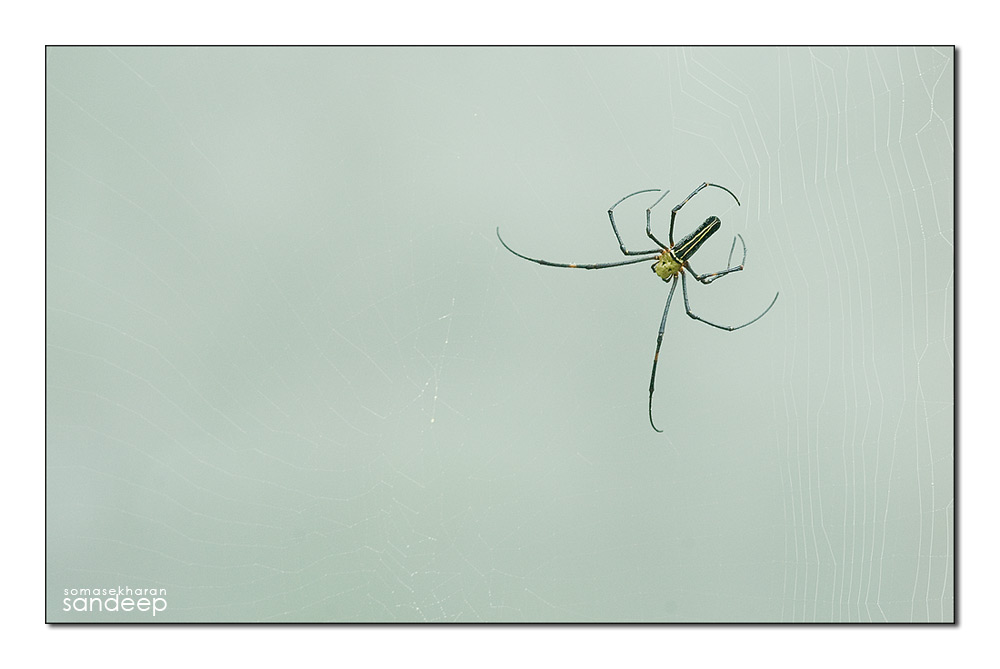
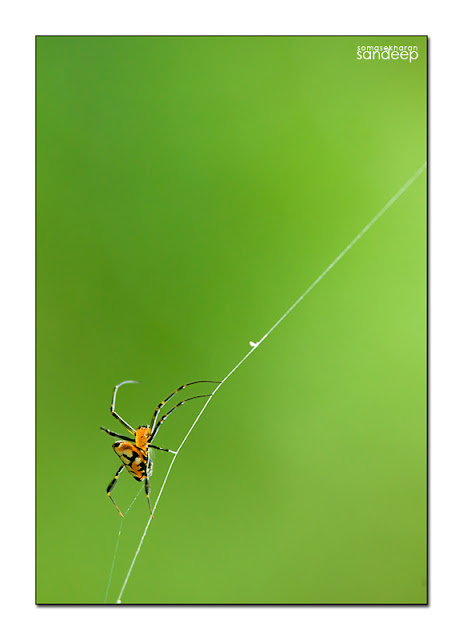
They were everywhere when we went out for a stroll in the forests of Dandeli two weeks ago. And all kinds of them. There were Giant Wood Spiders (Nephilia maculata) and the handsome Black Wood Spiders (Nephilia kuhili), and a couple of (suspected) Leucauge spiders, and several unidentified ones. Mostly, I enjoyed watching and photographing those amazing Giant and Black Wood Spiders, and here is what I saw.
Lady Blackwood?
Giant Wood Spider enjoys the quiet of a misty morning
The Lady and her tramp (the tiny black speck to the right is Mr Giant Wood Spider). Talk about equality for women...
Possibly a Leucauge spider - can someone confirm?
The underside of a Giant Wood Spider. Is the red funnel a vent?
Another Leucauge spider performing a high wire walk
Topsy turvy
End of show. That's all, folks!

Text and photos by Sandeep Somasekharan

Ramble through Alaska - Exit Glacier

At Exit Glacier, not far from the top of the world as the puffin flies, we stayed at a historic hotel and stayed clear of bears


We were drained from the previous day’s drive to the Arctic that ended only at 3 AM on Day 3 of our trip at Seward, Alaska. Seward is a tiny town in the southern part of Alaska in the Kenai Peninsula, named after William H Seward who negotiated the purchase of Alaska. The town offers access to the Kenai Fjords National Park and the Exit Glacier, which were in our itinerary for the next two days. We had stayed at the Hotel Van Gilder -- a historic hotel in Seward.

Exit Glacier
Built in the early 20th century, Hotel Van Gilder has seen the metamorphosis from an office building, hotel, women’s dormitory to its final use as a historic hotel. We were impressed with its interiors and furnishings, which gave us the feeling that we were indeed staying at a place of historic significance. The interiors, with their Italian feel, reminded me of another place where I had stayed at Miami Beach.
Hotel Van Gilder, Seward, Alaska
We had a three-hour nap as we had to get to the Harding Ice Field Trail to begin our hike. The weather was not benign and there was a continuous drizzle. A rather gloomy day compared to the heaps of sunlight we had received the day before. When we got to the visitor’s center for the Exit Glacier we could hear a lot of talk about bears in the area, and we made the necessary enquiries on how to evade bears, which included making a lot of noise and trying to look larger than the bear by spreading out the limbs high, or using a pepper spray (which we didn’t have). We then proceeded with caution. We passed a few hikers on the way back and some warned us about bears in the area. After about 30 minutes into the hike Raghavan and I decided we didn’t want to be hugged by any bears. I was reminded of a lesson my high school English text book about a hiker who was attacked by a bear that took out his scalp with one blow. Rajarshi was nonchalant about the bear threat and decided to continue all alone. 

A cruise ship at Resurrection Bay
We hung around for short hikes at the base of the glacier and were pained to read about how it had receded over the past years. Back at Seward Raghavan and I ate and headed out to explore the town's streets, a journey that took us to Resurrection Bay. Back at the hotel we were joined by Rajarshi who related his hike experience, the friends he had made, and a black bear he had spotted along the glacier.
Colorful mural on the wall of a restaurant
We ended the day with a visit to a local watering hole where we caught up with the friends Rajarshi had made during the trek -- two from the Czech Republic and one from Japan -- and we exchanged notes on our travels and headed back hoping we could catch glimpses of puffins, sea lions and whales during our cruise at the Kenai Fjords National Park.

Text and photos: Anand Yegnaswami
Lead Photo: Public Domain


Read previous posts in the Alaska series

Odyssey to Bedni Bugyal - In another world

In the charming alpine meadow of Bedni Bugyal life goes on as if on another planet, though Jennifer Nandi notes that our inexorable worldliness has preceded our arrival here 
Life's symmetry, reflected in Bedni Kund
Trishul peeks fleetingly behind scudding cloud and the earth is white. I can hear melt- trickles from beneath the snow. Here, at its source, the Bedni Ganga trickles from under an overhang of ice. The upper reaches of this river are clear, rich in oxygen but poor in nutrients. Yet its narrow bed and fast-flowing waters possess considerable erosive abilities – both by chemical weathering of the rocks over which they pass and by the abrasive action of rock particles. 

Nanda Ghunti peeks through a veil of mist
Last night’s hail and snow has buried all irrelevant detail. The bright yellow flowers of a cluster of Marsh Marigold – of the Buttercup family – spring silently by the brook, nestling against a boulder. Such flimsy things they seem, just a step up from the leaves, with no heft. Yet last night’s blast of cold wind has neither withered nor shrivelled it. Frost failed to kill its basal, toothed, shining blades. It sits an easy prey to hail, storm and blizzard, a miracle of growth. What strength in fragility! Some mountain species resist becoming frozen solid because of the sluggish liquid moving in their cells acting like antifreeze. The fragrant, lavender-coloured flowers of Primula atrodentata lift their compact globular head from their icy bed. The whole flower vibrates with the attention it’s getting. The true miracle in the mountains is the manner in which every vestige of decay is seized upon by the roots of plants. 
Marsh marigolds are a burst of vibrant colour against the bleakness of the landscape
The Bedni springs from hidden aquifers under the earth. It will serve us during our brief stay here. I gargle and spit and wash and pollute this spring at its source. I hurry down to the ‘kitchen,’ with visions of hot porridge. Devidutt is warming himself in a blazing fire. There is an unusual amount of light streaming through. I look up – more rafters are missing… I take our entire ration of dalia, cook it with some vermicelli, milk and sugar – the result, a whole load of very appetizing nourishingly sweet porridge. The men arrive and devour the breakfast with great relish. They let us know, much later of course, that they had already swallowed the morning’s quota of energy bars! Sunita and I sit outside, hands cupped around our comfort food, and decide that as wonderful as this is, we are too old to trek with the cooking left to us. Devidutt is a guide with no training, content to lie back like some Old World nawab, one knee cocked, a cigarette (Sunita’s preferably) dangling from his thin lips. His small and subtle artifices to absent himself from volunteering a service exasperated Bijoy. The pony-owners are always ahead of us in one-third or one-fourth the time we take to arrive camp. With a fee I’m sure they could’ve been entrusted to make tea, cook us some breakfast and a meal at the end of the day. 

We turn to look upon the mountain peaks of Trishul and Nanda Ghunti. Thick, irregular and scattered clouds float past the peaks, between us and the sun. The thinner edges of the clouds, more efficient at scattering light forward toward our eyes, shine brightly giving them a silver lining. For this moment of pure magnificence, all is worth it – our hunger, pain, suffering, fatigue, our insecurities and anxieties – all fall away. It is true that the wilderness can revitalize. We fill ourselves with wonder and awaken the genius in us that can infer the vanished past from a hint of rock. 

‘Let’s go birding’, we say, with energy anew. 

Green Ogre Autumn Conclave Dandeli - Trip Report

Dandeli, post-monsoon, is a completely different forest. Quieter, darker, denser, and offering a whole new birding experience that left us unsatisfied


A misty morning welcomed us as we got down at the VRL bus stand at Dandeli and through the veil of vapor we could see three Malabar Pied Hornbills (Anthracoceros coronatus) flying towards the sylvan surroundings of the Dandeli Bus Stand. The portent was promising and looking forward to a lifer-rich three days we headed towards the Kulagi Nature Camp in the Dandeli-Anshi Wildlife Sanctuary. While the fog was still thick, reducing the visibility to less than 50 meters, we peered eagerly looking for some life outside. 
Giant Wood Spider on the way to Kavala Caves
On the way we spotted a Common Woodshrike (Tephrodornis pondicerianus) on an overhead power cable, though it took us a while to ID it through the mist. The black eye patch was evident, the beak and head seemed to concur, yet the colors didn’t seem to match. Jennifer mentioned that there is a race of Common Woodshrikes that is grey unlike the commonly seen brown variety. We moved on and spotted a Stork-billed Kingfisher (Pelargopsis capensis), some munias on a powerline on the way, and arrived at Kulagi Nature Camp.
Malabar Pied Hornbill in flight
At the camp we spotted a pair of Asian Fairy Bluebirds (Irena puella) and marvelled at the busy sorties of the Crested Tree Swifts (Hemiprocne coronata) and Alpine Swifts (Apus melba). Chestnut-headed Bee-eaters (Merops leschenaulti) were busy with their aerial maneuvers and offered us quite a sight while we were chalking out the plan for the day. Sandy brought out his camera to take a picture of a Chestnut-headed Bee-eater, to the sad knowledge of a glitch. The Nikon D300 was not powering on and Sahastra offered his Nikon D700. Being a full frame camera, the D700 shrank the effective focal length of Sandy’s lenses by a factor of 1.5. Yet this was better than having nothing and we moved on to finalize the logistics for the next two days.

A Chestnut Headed Bee-eater
We found Dastagir, the guide who had accompanied us to the Nagzari waterfall trek the last time we were at Kulagi, and he was more than eager to join us again. It was, however, at the office at the camp that we faced our greatest challenge. As we had intended to go birding along the Kavala Caves trail the next day we spoke to the staff at the office who, though initially helpful, started putting up one caveat after another and our birding trip seemed in jeopardy as we were told that the safari vehicle would not start if the quorum of nine was not met. We were seven and human; had we been earthworms we could have tried the slice-and-regenerate approach to make up the numbers. Rather flustered, we walked towards the birding trail. 
It was already close to noon and we were not looking forward to much as we entered the birding trail, which at this time of the year was lush green compared to the dry brown we had found it to be in April. We spotted the Black-hooded Oriole (Oriolus xanthornus), Velvet-fronted Nuthatch (Sitta frontalis) and Chestnut-bellied Nuthatch (Sitta castanea). We spent some time observing the Black-rumped Flameback (Dinopium benghalense) and, as Jennifer explained, looking at the throat is an easy way to identify this bird -- it has a clear black throat.
A spider weaves a web of deceit


After a rather pedestrian lunch at one of the canteens (which we swore not to repeat), we came back to see an exhibition of live snakes as a part of the Wildlife Week. The friendly forester handled the Forsten’s Cat Snake (Boiga forsteni) -- so named for its prominent feline eyes. The mildly venomous snake, no threat to a full-grown human, presented me with my first experience with handling snakes, which I had been looking forward to for a long time. Arun stepped in and shared some of his knowledge on handling snakes – moving our palm along the snake’s underbelly gives the snake the feeling of being in motion, he said. We also saw and felt the Green Vine Snake (Ahaetulla nasuta) and the difference in the temperament of the two was stark. The Cat Snake was more active and mobile, while the Vine Snake, an ambush hunter, stayed mostly still.
Forsten's Cat Snake - Wildlife Week at Dandeli
Meanwhile, we settled the terms for our trek to Kavala Caves the next day. We birded near the camp for the evening as there was a huge cloud build-up and it started to rain. 
Look into the eye of the cat snake and thou shalt be turned to stone
Day 2 started early for us by and we were raring to go by 6 AM, but due to the mist and other operational procedures we started only by 6:45. 
We took the jeep to get into the sanctuary and were to trek from a trailhead that began at  a watchtower near a water body. On the way to the watchtower we spotted a Crested Serpent Eagle (Spilornis cheela) perched on a tree; the crest was visible as it turned its head right. After observing it for a while we drove on and, as we reached the trailhead, spotted a Lesser Adjutant (Leptoptilos javanicus) in the pond. It lingered for a while and then took off and perched on a tree. The bird has white undertail coverts that form a runny pattern on its back. As the bird flew we could see that flies with its head retracted (unlike Painted Storks) and it was marked with black under the wing.

We observed Black-headed Munias (Lonchura malacca) and spotted a White-rumped Shama (Copsychus malabaricus) in a bamboo thicket. This was a male as it was jet black (the female is duller) and it had a chestnut belly and often twitched its tail like a robin. Its melodious call ends with a drop in pitch -- like a question. We observed them for some time and moved on. We spotted several spiders -- the two species we could identify were the Giant Wood Spider (Nephila maculata) and Black Wood Spider (Nephila kuhlii); there were also some species of Arigope spiders. Up in the canopy we saw Common Wood Shrikes, Velvet-Fronted Nuthatches and Bronzed Drongos.  
Closer to the Kavala caves Arun and Bijoy spotted the Grey-headed Canary Flycatcher (Culicicapa ceylonensis).  
Velvet-fronted Nuthatch

On our way back we saw the Heart-spotted Woodpecker (Hemicircus canente) and the Brown-capped Pygmy Woodpecker (Dendrocopos moluccensis), a rather small woodpecker with brown streaks along the underparts. On the drive back we spotted some chitals (Axis axis) -- a stag and two does -- near what appeared to be an artificial salt lick.
Asian Brown Flycatcher
After lunch we arranged for a vehicle to take us to the Bommanahalli backwaters where we were hoping to findwading birds. We were disappointed when we reached -- there was nothing except Grey Herons (Ardea cinerea), Great Egrets (Ardea alba), Little Cormorants (Phalacrocorax niger) and White-throated Kingfishers (Halcyon smyrnensis). There were a lot of frogs, though. We headed back to camp for birding. 


Back at the camp we headed back to the Bird Trail and spotted Black-lored Tits (Parus xanthogenys), Small Minivets (Pericrocotus cinnamomeus) and Bronzed Drongos (Dicrucus aeneus) but the highlight was a spotting by Bijoy -- a Banded Bay Cuckoo (Cacomantis sonneratii) being fed by a Common Iora (Aegithina tiphia). This was the first time I had observed brood-parasitic behaviour. We headed towards the Timber Trail where we saw a Green Vine Snake, which had some warts along its belly. It looked like rain and we cut short our walk and headed back to plan the next day. We were looking at good birding options and Sahastra suggested that our chances of finding birds 30 km away were the same as that of finding them next to our camp. This prophecy saved the next day for us as we headed out to the watchtower overlooking the Nagzari Valley.
Crested Serpent Eagle
On a dry tree near the check dam we found a mixed flock including Pompadour Green Pigeons (Treron pompadora), Heart-spotted Woodpecker, Bronzed Drongo, Brown-capped Pygmy Woodpecker, Common Woodshrike, Scarlet Minivet (Pericrocotus flammeus). At the watchtower we observed the Brown-headed Barbet (Megalaima zeylanica), Golden-fronted Leaf Bird (Chloropsis aurifrons),  Bar-winged Flycatcher Shrike (Hemipus picatus), Velvet-fronted Nuthatch, Plain Flowerpecker (Dicaeum concolor), Purple-rumped Sunbird (Nectarinia zeylonica) and Crimson-backed Sunbird (Nectarinia minima) from a close distance. The elevation of the overlook near the watchtower was just perfect for us to watch these birds at eye level. We then covered the Bird Trail from the opposite direction.
A Malabar Grey Hornbill
We checked out and headed towards the Timber Depot hoping to spot some hornbills. On the way we saw two jackals crossing the road. The Timber Depot was lush green and we did find two Malabar Grey Hornbills (Ocyceros griseus) calling, and we were told that there are more birds to be seen further up the road near a meadow. The locals mentioned that the hornbills would arrive in huge flocks around 6:30 PM and also suggested the possibility of finding flying squirrels and deer. That got our hopes up but a hike into the forest beside the meadow was disappointing. As we passed time in an excruciating wait, Jagadeesh brought our attention to a blind snake being consumed by ants; the snake’s predicament was pitiable and painful, though we watched in marvel at the coordinated attack of the ants. The formic venom took effect and the blind snake was soon subdued.
Some species get to monkey around and no one can complain
It was dark and we left the Timber Yard in sober spirits. The omen of spotting the Pied Hornbills on our arrival apparently had no bearing on the bird life we were going to spot during the trip. After some struggle to find a reasonable dining place in Dandeli we boarded the bus to Bangalore.
Triplist:

  1. Grey Junglefowl (Gallus sonneratii)
  2. Indian Peafowl (Pavo cristatus)
  3. Lesser Adjutant (Leptoptilos javanicus)
  4. Little Cormorant (Phalacrocorax niger)
  5. Grey Heron (Ardea cinerea)
  6. Great Egret (Ardea alba)
  7. Pond Heron (Ardeola grayii)
  8. Oriental Honey Buzzard (Pernis ptilorhyncus)
  9. Indian Black Eagle (Ictinaetus malayanus)
  10. Brahminy Kite (Haliastur indus)
  11. Crested Serpent Eagle (Spilornis cheela)
  12. Red Wattled Lapwing (Vanellus indicus)
  13. Spotted Dove (Streptopelia chinensis)
  14. Pompadour Green Pigeon (Treron pompadora)
  15. Emerald Dove (Chalcophaps indica)
  16. Banded Bay Cuckoo (Cacomantis sonneratii)
  17. Common Hawk-Cuckoo (Hierococcyx varius)
  18. Asian Drongo-Cuckoo (Surniculus lugubris)
  19. Asian Koel (Eudynamys scolopaceus)
  20. Blue Faced Malkoha (Phaenicophaeus viridirostris)
  21. Greater Coucal (Centropus sinensis)
  22. Alpine Swift (Apus melba)
  23. Crested Tree Swift (Hemiprocne coronata)
  24. Stork Billed Kingfisher (Pelargopsis capensis)
  25. White-Throated Kingfisher (Halcyon smyrnensis)
  26. Chestnut Headed Bee-Eater (Merops leschenaulti)
  27. Green Bee-eater (Merops orientalis)
  28. Malabar Grey Hornbill (Ocyceros griseus)
  29. Malabar Pied Hornbill (Anthracoceros coronatus)
  30. White-cheeked Barbet (Megalaima viridis)
  31. Coppersmith Barbet (Megalaima haemacephala)
  32. Brown Headed Barbet (Megalaima zeylanica)
  33. Brown Capped Pygmy Woodpecker (Dendrocopos moluccensis)
  34. Lesser Yellownape (Picus chlorolophus)
  35. Rufous Woodpecker (Celeus brachyurus)
  36. Black Rumped Flameback (Dinopium benghalense)
  37. Greater Flameback (Chrysocolaptes lucidus)
  38. Heart Spotted Woodpecker (Hemicircus canente)
  39. Common Woodshrike (Tephrodornis pondicerianus)
  40. Large Cuckoo-shrike (Coracina macei)
  41. Long-tailed Shrike (Lanius schach)
  42. Ashy Woodswallow (Artamus fuscus)
  43. Common Iora (Aegithina tiphia)
  44. Small Minivet (Pericrocotus cinnamomeus)
  45. Scarlet Minivet (Pericrocotus flammeus)
  46. Bar Winged Flycatcher Shrike (Hemipus picatus)
  47. Black Hooded Oriole (Oriolus xanthornus)
  48. White Bellied Drongo (Dicrurus caerulenscens) 
  49. Bronzed Drongo (Dicrucus aeneus)  
  50. Greater Racket Tailed Drongo (Dicrurus paraiseus)
  51. Asian Brown Flycatcher (Muscicapa dauurica)
  52. Grey Headed Canary Flycatcher (Culicicapa ceylonensis)
  53. Black Lored Tit (Parus xanthogenys)
  54. Chestnut Bellied Nuthatch (Sitta castanea)
  55. Velvet Fronted Nuthatch (Sitta frontalis)
  56. Red Whiskered Bulbul (Pycnonotus jocosus)
  57. Yellow Browed Bulbul (Iole indica)
  58. Brown Cheeked Fulvetta (Alcippe poioicephala)
  59. Asian Fairy Bluebird (Irena puella)
  60. Oriental Magpie Robin (Copsychus saularis)
  61. White Rumped Shama (Copsychus malabaricus)
  62. Orange Headed Thrush (Zoothera citrina)
  63. Jungle Myna (Acridotheres fuscus)
  64. Chestnut Tailed Starling (Sturnia malabarica blythii)
  65. Indian Myna (Acridotheres tristis)
  66. Golden Fronted Leafbird (Copsychus saularis
  67. Plain Flowerpecker (Dicaeum concolor)
  68. Thick-billed Flowerpecker (Dicaeum agile)
  69. Purple Rumped Sunbird (Nectarinia zeylonica)
  70. Crimson Backed Sunbird (Nectarinia minima)
  71. Scaly Breasted Munia (Lonchura punctulata)
  72. Black Headed Munia (Lonchura malacca)
  73. White-browed Wagtail (Motacilla maderaspatensis)
  74. Grey Wagtail (Motacilla cinerea)
  75. Tickell's Blue Flycatcher (Cyornis tickelliae)
  76. Black-naped Monarch (Hypothymis azurea)
  77. Rose-ringed Parakeet (Psittacula krameri)
  78. Malabar Parakeet (Psittacula columboides)
  79. Plum-headed Parakeet (Psittacula cyanocephala)
  80. Vernal Hanging Parrot (Loriculus vernalis)
Text: Anand Yegnaswami
Photos: Sandeep Somasekharan


Read more posts from our Dandeli series