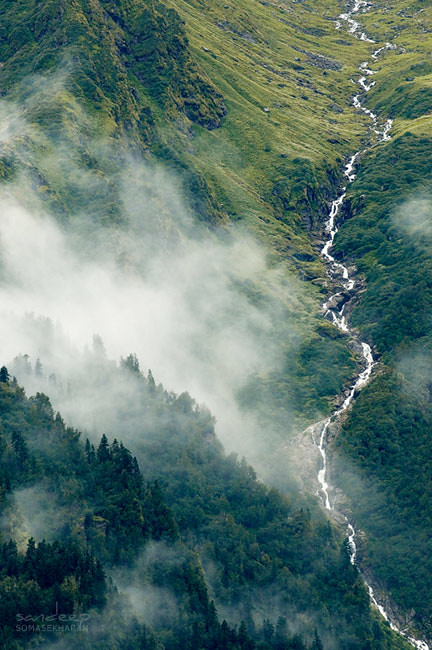
Bright-eyed and bushy-tailed, we set off from Didana the next day on what we’ve been told is roughly an “eight-kilometre easy trek” to Bedni Bugyal. We should be there for a late afternoon lunch. We couldn’t have been further from the truth!
We walk the flanks of the mountain and descend quickly to a trickling brook. Scrubby bushes and a higher-altitude variety of stinging nettle encroach upon our path, breaking their needles of poison on the edges of our trousers. Stinging nettle thrives in the phosphate-rich soil around human habitation. In most soils and waters, phosphorus is in short supply. Decomposers return phosphorus to the soil as the phosphate ion. A phosphorus atom, unless lodged deep in the earth, is therefore likely to spend much of its time in organisms.
A shepherd sits under the shade of an old tree, guarding his precious herd of sheep and goats. The shepherds’ goats roam the hillsides devouring their favourite food of slow-growing oak saplings.

We ascend swiftly through straggly oak and rhododendron. It is difficult to imagine that this was once part of a rich forest that clothed the hillsides from the Indus to Bhutan at an altitude from about 1500 m to 3000 m. Today, scant patches of that ancient green belt are the only reminders of its past glory. The large evergreen “Ban” Oak had once been the best known of the Himalayan oaks.
There should be many Black-throated and Eurasian Jays wedging acorns into crevices to split the shell with their ice-pick beaks to get at the seeds. But birds are indicative creatures. They know this forest offers little nourishment. Lopping interferes with the regenerative ability of a tree.
Acorns from adult oaks carry very large stores of food to sustain oak seedlings through their difficult first months. A mature tree may carry as many as 90,000 acorns. Oaks are slow growing. Eventually, they may stand four storeys high to provide boarding and lodging for birds and animals.
Within the roots live beetle larvae. Concealed in crevices of the bark are tiny moths. They lie dormant during the day and fly around the branches at night. And just beneath the bark, beetles burrow radiating galleries in the wood. Hunting for the beetles are Himalayan Woodpeckers. The birds favour a mixed coniferous and temperate forest and, as we leave Didana far behind, these handsome pile-drivers are everywhere.

Epiphytes cloak the bare branches of the oak thickly enough to provide a safe haven for nesting Asian Brown Flycatchers, which are just all over the place. So are Green-backed Tits. One tit, with its mouth crammed with food for its young, takes such a detour to approach its nest hole that we had to pause our predestined aptitude for peering, to allow it some privacy.
Oaks once grew abundantly in association with Rhododendron arboreum and occasionally the Deodar, forming the chief tree of a well-known class of forest. How resplendent the rhododendron must have been with their large compact clusters of red flowers which contrast so strongly with the glossy green leaves. The Rhododendron is either lopped for firewood or its flowers picked to be processed into a kind of sweet drink that is sold by every ‘juice’ shop along Himalayan hill-station roads.

Plantations of Chir Pine, Pinus roxburghi, were planted in place of the primary forest of mixed conifers. This species of tree does not support undergrowth. In the dry season, the tinder-dry pine needles quickly catch fire and, in the monsoon, with little top soil to protect the earth, the rain washes swathes of mountainside down in ubiquitous landslides.
The gradient is now steeper than before and we pause every now and then for breath and for an awareness of where we are. A male Kaleej pheasant sporting a long white crest with white barring on its rump, contrasting nicely with the blue-black of its body, gives us a glimpse of its bright red facial skin before scooting off into a deep gully.
The forest opens. Grey-headed Canary Flycatchers signal their presence with their short interrogative whistles. Tits and tree-creepers are everywhere. But their whistled introductory notes followed by a rapid penetrating accelerating trill, is quite distinct from the high-pitched chi-chi-chi-chi-chiu-chiu-chu trill of what we are more accustomed to.
This bird is a tree-creeper with a straighter bill and with so much more patterning – dark ear-coverts with a nice creamy breast and belly and it is ever so rufous on its flanks. These Rusty-flanked Tree-creepers chase each other and settle frequently on the barks of trees, creeping up the vertical trunks and along the underside of branches, spiralling upwards in a series of jerks, probing the cracks and crevices in search of insects and spiders. Such lively behaviour – is it indicative of nest-building?
Why do we climb? We pit our strength against difficulty; we endure hardship, discomfort and danger. It is almost as if we negate outward agencies of any kind – we put aside competition, we deny our otherwise prevalent sense of separateness, we reject the fake. We see the mountain’s magnitude, its immensity, and in doing so we drive out our pettiness. On occasion, we are so fully absorbed that we escape not just from the ugliness of greed, of noise, of noxious fumes, but from our very selves!