We’ve moved! Here’s where you can find us

The Green Ogre is now at https://www.greenogreindia.org

The Green Ogre Weekend Update July 31

Alaska, Gaia and birds whose presence is dwarfed by their voices -- that's what The Green Ogre was all about this week 

It's the last day of July with the monsoon still in full force over the subcontinent. In the rainforests of Agumbe, the frogs must still be calling, their trails of spawn must have hatched into little tailed tadpoles, and the snakes must be making merry at the abundance of chow. Over in Bangalore, pelicans have joined cormorants and herons in our lakes, feasting on the seasonal glut of fish. And here at The Green Ogre, we've been housebound, office-bound and our mindwalks have been extra vivid with the afterglow of unrealised dreams. The bright side: deprived of the outdoors, we sat down to write. 

Andy recalled his ramble through Alaska's Denali National Park and his encounters with moose, elk, caribou and grizzlies. In weather that was all but conducive to hiking, his friends and he flirted with the possibility of catching a glimpse of the mist-shrouded Mount Denali. Interestingly, they drove through the city of Wasilla on the same night that its former mayor and Alaska's then governor Sarah Palin was announced as John McCain's running mate in the 2008 US Presidential Election.

On Tuesday the birds came back to The Green Ogre. Recollecting a drive through his native land of Rae Bareli before the birding bug had bitten him, Sahastra described in all self-deprecation his first encounter with the Rufous-tailed Shrike. Many passers-by must have walked past the bird that day without as much as glancing at it. However, to a birder, its presence there at that time of the year was an epiphany: it was way out of its known range. Such are the serendipitous joys that await the birdwatcher, even in his or her backyard.


July 26 was the 92nd birthday of James Lovelock, who proposed the enchantingly controversial Gaia hypothesis. Offering an appreciation of the man and his work, Sahastra wrote: "Gaia as an idea has both scientific and spiritual sides. This is welcome since it helps us connect science to worldliness and makes us feel complete again. Many paint James Lovelock as a hermit scientist who never followed institutional science, has no specialization and worked in a remote corner of the British countryside rather than in a state-of-the-art lab. Lovelock said that it is precisely due to these attributes that he could think large, be moved by his own curiosity and inspiration and break the boundaries between disciplines. Eventually, inspired by the first space images of the beautiful blue planet with swirling clouds, he was able to theorize the self-regulation of Earth – true to his instinct, he called it a living earth."
Among the most commonly heard but ignored birds of our urban landscape is the Coppersmith Barbet. Its penetrating took-took call is an indelible constituent of park birdsong. Indeed, the Coppersmith's penchant for monotony makes it the heavy metal percussionist of bird songsters. How much have you seen of the little bird, though? Take a good look, for Sandy has an excellent photographic profile of this little whiskered noisemaker.

Look out for more good stuff next week. Enjoy your weekend!

Encounter: The Coppersmith Barbet


More often heard than seen, the diminutive Coppersmith is a thousand times smaller than its enormous voice

Once a while we may be treated to the sight of a coppersmith perched this low
I was on my first ever trip to Ranganathittu Bird Sanctuary near Mysore, when I had a flat tire halfway through. As I pushed my two-wheeler along with my friend for kilometers looking for a pile of tires or a board screaming "puncher" (or variants of it) advertising a puncture mechanic in these parts of the world, I saw a strikingly colorful bird on an electric line. It was predominantly dark green, with striking red tufts above the beak and under the chin. It sat there, tilting its head left and right, and then took off. And I came home, thumbed through my Salim Ali (this was before I graduated to Grimmett and Inskipp) and found the name -- Coppersmith Barbet (Megalaima haemacephala).
 
A not-so-ripe fig makes a Coppersmith look elsewhere...
I had to wait a while before I came to realize the philosophy behind the intriguing name. I came to hear (and see) it calling high up from a treetop with its neck craned -- whatever little it could manage with that short neck - and letting out a full-throated but short ringing tuk... tuk.... Apparently, this call earned the bird its name as it sounded, to the imaginative listener, like a coppersmith flattening out a sheet of his metal with a mallet.
Once his mind is set on it, no fig is too large!
Sexes are alike and juveniles are cute variants of the adults sans the red above the beak and below the eyes.
A juvenile, lacking the red crest and throat patch
The coppersmith is mostly a frugivore and a voracious fig eater -- if you see a fig tree with a large number of ripe fruits, take a closer look: the coppersmith barbet is invariably in there.
Who said three's too many?
The Coppersmith Barbet has survived in semi-urban areas and cities that offer fruiting trees for food, and cavities on tree trunks for nesting. If you still find the bird uninteresting you also might change your opinion when I tell you that it is the official bird of the city of Mumbai. That is a fitting honor for a resilient bird that is clinging on despite rampant urbanization.

Text and photographs by Sandeep Somasekharan

Gaia and the Lovelock legacy


James Lovelock, whose birthday fell on July 26, proposed the compelling but controversial idea of Gaia. Sahastrarashmi offers an appreciation of the man and his work


Gaia as metaphor; Gaia as a catalyst for scientific enquiry; Gaia as literal truth; Gaia as Earth Goddess. Whoever she is, let’s keep her. If science cannot find room for the grand vision, if Gaia dare not speak her name in Nature, then shame on science. To recant now would be a terrible thing, Jim. Don’t do it.
- Fred Pearce

We looked at the Earth in our imagination, and therefore with fresh eyes, and found many things, including the radiation from the Earth of an infrared signal characteristic of the anomalous chemical composition of its atmosphere.  This unceasing song of life is audible to anyone with a receiver, even from outside the Solar System. 
- James Lovelock

In simple terms, the GAIA theory states that planetary environment is regulated, or is homeostatic, and if we consider the sum of all life on this planet, Gaia, we realize that it is this self-regulation that allows optimum conditions for life to exist. In other worlds, Life maintains the conditions that allow it to thrive over geological time. Some commentators have extrapolated from here that Earth is a living organism since like any (super) organism it exhibits physiological processes that keep it functioning. Lovelock has supported this view.

There is enough evidence for planetary self-regulatory cycles and, as scientists continue to explore and research them, the role of Life in some of these cycles has been established beyond doubt. In fact, the hunch that a planetary-level self-regulation could possibly exist on Earth came from looking at one of these processes – methane replenishment.

While at NASA, Lovelock was struck by the seemingly inert and stable equilibrium of gases on other planets. However, on Earth he observed that gases like methane occurred in quantities higher than otherwise physiologically possible. Methane reacts with oxygen and should ideally vanish, but its constant presence in the earth’s atmosphere meant that it was being produced constantly. Lynn Margulis later pointed out the origin of the gas as coming from living organisms like cattle  (through belching). Lovelock termed this as a dynamic equilibrium where the composition of such reactive gases was being maintained by their constant production by Life and this led him to the insight that perhaps Life was responsible for the continued habitable conditions on Earth. Looking at the dynamic composition of the Earth's atmosphere and the near-equilibrium atmosphere of other planets (in this case, Mars), Lovelock argued that there is no life on Mars, which NASA's probes later confirmed.

Gaia, according to Lovelock, maintains the temperature of the planet, the composition of gases and the alkalinity of oceans among other things.

For instance, Lovelock points out, the luminosity of the sun has gone up by almost 30 percent over the past 4.5 billion years (Earth’s age) but the surface of the earth has not heated up in proportion. This, Lovelock argues, is due to Gaian regulation that occurs due to the reduction in greenhouse gases over time and the maintenance of cloud cover (albedo). Similarly, oxygen is maintained at 21 percent. Anything more than 25 percent means that woods will catch fire, and less would threaten the existence of life. This composition is so well regulated that the volume of atmospheric oxygen has not varied by more than 5 percent from 21 percent for the past 200 million years.

Another interesting temperature regulation system is the Thermohaline system described by Tyler Volk. In his book, Gaia’s Body, he describes this convection cycle of cool and heavy salt-rich waters sinking down at the poles and then spreading through the oceans in a series of upwells, which then move towards the poles. This convection cycle that takes 1,000 years to complete one revolution. This, along with the winds that stir up due to equatorial heating and polar cooling set up a heat pump that normalizes the temperature extremes that would otherwise result. Volk calculates that without this “circulatory” system, the temperature at poles would be -90 degrees Celsius (instead of -23) and 60 degrees instead of 26 at the tropics. A very inhospitable planet!

Gaia hypotheses came under strong attack from Neo-Darwinists, climatologists and geologists. So strong was this attack that Lovelock likened it to a cold-water dip – an absolute shock to the body but accompanied by a clearing of the head. Evolutionary biologists attacked it for its teleological nature – it suggested that the organisms and the environment had somehow conspired to create this regulated system. This is an impossible task for organisms to accomplish since they are locked in their struggle to survive; these selfish individuals operate at the level of their immediate environments. They cannot possibly take actions that benefit the planet overall while entailing a cost to them (thereby loading the cost-benefit equation against their survival). Dawkins pointed out that the Earth cannot be an organism (hence self-regulatory), since it did not evolve out of natural selection as species do.
The attack was more scathing since Gaia and the idea of Mother Earth resonated with new-age mystics, environmentalists, etc. who found the romantic idea of a living Earth emotionally enriching. The scientific community condemned this takeover and the resultant mystic overtones in popular culture. Moreover, the idea of a living Earth recalled animist traditions which post-Descartes science was loath to be associated with. At a deeper level, the phenomenon of planetary regulation is seen as emergent phenomena by Gaian scientists, where higher-level phenomena cannot necessarily be broken down to parts and explained entirely on that basis. This runs against the grain of reductionist science. Underscoring this point Margulis wrote: “The sum of planetary life, Gaia, displays a physiology that we recognize as environmental regulation. Gaia itself is not an organism directly selected among many. It is an emergent property of interaction among organisms, the spherical planet on which they reside, and an energy source, the sun.

Over the years the evidence of impact of life on these planetary regulatory processes has built up. An interesting finding in this regard was the discovery that the planetary cycle that replenishes sulphur on land (the sea is rich in sulphur and the land is poor in it) involves a gas dimethyl sulphide that is produced by marine algae and carried to land by wind. Moreover, it was found that this gas has a vital role in seeding clouds, which are critical temperature regulators. Water molecules must condense on nuclei to form clouds -- these nuclei are provided by marine algae Emiliania huxleyii which emit DMS in the first place. 

Another living organism that aids rain-making is Pseudomonas syringae which catalyzes the freezing of water. Since this bacterium is found on crops, scientists speculate that cropping patterns may influence rainfall. This was reported on BBC's website: “Before rain can fall - at least in temperate climates - the water in clouds has to freeze. But - and you may not believe this - sometimes, water doesn't freeze at [0 degrees Celsius]. Pure water will not freeze until -40C, and clouds rarely get that cold. So to get water to freeze you need some help. A catalyst such as soot or dust will do the trick but if you want water to freeze at relatively warm temperatures, say around -5C or -6C, bacteria turn out to be the best "ice nucleators". But these organisms can easily get carried off by the wind and, once airborne in the clouds, pull off the same trick and persuade water droplets to freeze. At least that's the theory. 

"It's a big question," admits Morris. "Are they involved in the events that lead to rain formation? Because if they are - these bacteria are the products of agriculture - does agriculture have any consequence for the amount of rain that could be formed?


There is absolutely no doubt that Gaia has opened up new areas for research and combined disciplines that were used to working in silos. The very nature of the theory requires a comprehension and inquiry must vaster than the narrow confines of disciplines such as atmospheric sciences, ocean studies, evolution or geology. This trend now reflects in our lives as well. Many hope that Gaian thinking may set this right. Philosopher Mary Midgley points this out when she writes: “Our moral, psychological and political ideas have all been armed against holism. They are both too specialized and too atomistic. As many people now point out, that slant is giving us trouble in plenty of other places, notable in many areas of medicine, especially mental illness, as well as over Gaia. Yet we find it very hard to change it.

Gaia as an idea has both scientific and spiritual sides. This is welcome since it helps us connect science to worldliness and makes us feel complete again. Many paint James Lovelock as a hermit scientist who never followed institutional science, has no specialization and worked in a remote corner of the British countryside rather than in a state-of-the-art lab. Lovelock said that it is precisely due to these attributes that he could think large, be moved by his own curiosity and inspiration and break the boundaries between disciplines. Eventually inspired by the first space images of the beautiful blue planet with swirling clouds, he was able to theorize the self-regulation of Earth – true to his instinct, he called it a living earth.

Gaia was born again.

Text and photos by Sahastrarashmi
Lead photo: Earth as seen by the Apollo 17 crew on December 7, 1972/ NASA Earth Observatory

Encounter: Rufous Tailed Shrike

Often, the stupidest questions elicit the most enlightening answers. Such was my initiation to the little featherball known as the Rufous-tailed Shrike. I'm glad I asked, though...


I am responsible for one of the dumbest questions in Birdingdom. This is a belated confession.

One fine February evening we were happily maneuvering a pot-holed road in Rae Bareli as GS scanned the acacia bushes beside the road for birds. Suddenly he exclaimed, “Rufous-tailed Shrike!" (Beams with excitement, asks driver to stop.)

I saw the bird and inquired, “Why is this Rufous-tailed Shrike?” It was actually three questions:

Why is this bird a shrike?
Why is it a Rufous-tailed Shrike?
What are you so excited about?

You must have realized that I had figured it was a bird. I also had a passing familiarity with the color rufous.

Prickled by the question but managing to keep his composure (the sighting helped), GS snapped, “Observe.”

This I did.

Lanius isabellinus is a small shrike with a hooked bill adapted for tearing flesh. It has a grey or sandy-brown mantle, a prominent rufous tail and grey-brown ear coverts. The male has a white patch at the base of the primaries (this is absent in the female) and the female has faint dark scaling on the breast and flanks. The bird in the last picture seems to be a first winter specimen since it has the overall coloration of the female (including the faint dark scaling on the breast), lacks the white patch at the primaries, but has the dark black lore of the male. The bird in Sandeep's photo (the lead pic) is an adult female (lacks the white patch on the primaries).
In winters the bird frequents wooded country along canals, riparian tracts and acacia vegetation along small roads. It breeds in the highlands of Baluchistan, southern Siberia and the Daurian steppes of central Asia.

The Rufous-tailed Shrike eats smaller birds, lizards and rodents and has the gruesome habit of impaling its prey on thorns and barbed wires. It is usually found atop bushes and small trees – a prominent perch for hunting. The bird we saw flew down and picked up a large ant (see pic below).
Going by the field guide that we were using, the shrike had no business to be there. However, one cannot really fault the birding guides for this as the basic information regarding winter and summer ranges of migrants is quite archaic – some of it survives from the days of Salim Ali and the British ornithologists. Bird checklists for some districts in UP are last updated by the district collectors and amateur British naturalists (A O Hume was the Collector of Etawah and the district is an exception, thanks to Gopi’s fieldwork. The checklist is quite current with 400+ birds). Most siting data continues to be reported from IBAs and established sanctuaries but very few birders visit the offbeat places, which are not well-known or are simply off-track. This leads to over-reporting from certain parts while creating birding blind-spots at the same time.

The grand old man of Indian ornithology was wise enough to avoid bias and made sure that he birded in places like Bastar, Bahawalpur, Districts of United Provinces, Afghanistan, etc. where few people venture today. He had birded in Rae Bareli and has reported the Siberian Crane from there. In my multiple visits to Samaspur, a bird sanctuary in the district, I have never encountered birders. The sanctuary staff tells me that such visits are fewer than a dozen in a year.

Moreover, the migrants can shift the wintering range based on factors like temperature, cropping pattern and rainfall. This is both seasonal as well as gradual shifts over time. This makes it all the more necessary for the data gathering to be extensive and well-planned.


The shrike sighting turned out to be good birding education. The presence of this elegant little predator indicated that the migratory season was well underway. Moreover, migrants can often be found in areas in which they have not been recorded earlier either due to a shift in range or gaps in information. So it's good birding practice to keep looking for them. This is where initiatives like MigrantWatch are both welcome and necessary since they enrich our knowledge about these lovely avian tourists as well as track shifts in arrival times and geographical spread.

Incidentally (now that I am on serial confession mode), I am also responsible for one of the most stupid answers in all Birdingdom. More on that later. Patience, dear reader. Or patientez s’il vous plait, in case you are Francophone.

Text and photographs by Sahastrarashmi (taken in Rae Bareli, Uttar Pradesh)
Lead photo by Sandeep Somasekharan (taken in Kutch)

A ramble through Alaska

Moose, elk, grizzlies and caribou are on Anand Yegnaswami's mind as he recalls a trip to Alaska's Denali National Park

Alaska was a part of Russia until 1867 when US Secretary of State William H Seward played a key role in purchasing it for $7.2 million. It is believed that the Russians were keen on the sale as having the Americans in their backyard would be a deterrent against the English. Most Americans felt that it was foolish to buy this barren patch of land and mockingly referred to the deal as “Seward’s Folly”. Mr Seward it appears was a man of profound foresight for despite the criticism he had mentioned that his greatest achievement was “the purchase of Alaska – though it will take people a generation to find it out.” Five generations later, I had an opportunity to seek out the truth myself.
The Thursday before Labor Day 2008, shortly before 11:30 pm (Alaska Time), Raghavan and Rajrishi from SFO, and I from Seattle landed at Anchorage’s Ted Stevens International Airport, picked up our rations at a nearby grocery store, and headed to Denali National Park.

Denali, which means “the tall/high one” in the Athabaskan language, is the highest peak in North America. The region around Denali, designated as the Denali National Park, is abundant in fauna. However, we were also hoping for a clear day to catch a glimpse of the peak itself, which is covered by clouds for most of the year.

Back at Anchorage, we were out on the Glenn Highway headed for Wasilla. Shortly after midnight of August 2008 (Alaska Time), John McCain announced Alaska governor Sarah Palin as his running mate for the 2008 Presidential Elections. I would like to think it was a mere coincidence that we passed by the town that day, for the quest we were actually on was Denali.
The road to Denali was desolate and serpentine with frequent changes in elevation. Quite often we would see light on the horizon and mistake it for the Northern Lights (Aurora Borealis). Whether this was the effect of fatigue from the long travel or a case of highway hypnotism we do not know. However, we made the same mistake knowing well that we could not expect to see the auroral phenomenon at that time of year. We saw some moose beside the highway in the early hours of the day and just about daybreak we reached the Park Visitor Center.

The Denali National Park is the only US National Park that does not allow personal vehicles inside the park. However, the authorities have ensured that ample shuttle buses are available to travel within the park. Shuttle buses are available for Toklat River (6.5 hours round trip), Eielson Visitor Center (8 hours round trip), Wonder Lake (11 hours round trip), Kantishna  (13 hours road trip). Our plan for Day 1 was the Eielson Visitor Center option as the duration seemed reasonable and we had planned to upgrade it to a Wonder Lake trip if Mt Denali was visible. Though we made enquiries about the Discovery Hiking Tour for day 2,  they were sold out. It was a cloudy day and it seemed unlikely that Mt Denali would be visible, yet we crossed our fingers and got into the bus.
Moose in Alaska (Douglas Brown/ Flickr)
On the trip to the Eielson Visitor Center, we passed a few solitary moose. The bus driver forewarned us to keep a safe distance from them while we were in the park, since it was the rutting season and solitary males were known to be very aggressive. After crossing the Savage River we came across a herd of caribou (Rangifer tarandus). Also known as Reindeer in Europe, these deer are both migrant and resident. The migrant herds are known to travel up to 5,000 kilometers in a year. The reindeer are food species for a variety of carnivores including wolverine, wolves, brown bear and Grizzly and we were about to meet one such foe. 
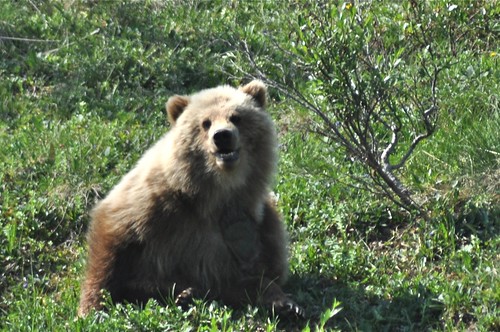
Further ahead of the Savage River we came across a mother Grizzly Bear (Ursus arctos horribilis) and her cub. Grizzlies are found in copious numbers in this region, though the irony is that they do not reproduce often. Females mate only from the age of five and they do not mate until a few years after the cubs leave, or are killed. The Grizzly Bear has very high nutritional needs as it needs to keep itself nourished through long periods of hibernation. Its diet includes berries, fish and large mammals such as moose, elk, bison, caribou and sheep. We were getting a good idea of the food chain of the region. Next we saw Dall sheep (Ovis dalli) as small white specks climbing high up on the mountain face.
Grizzly Bear in Alaska (dgrice/ Flickr)
Moving on we saw several shrubs that seemed to be ravaged by some form of pestilence. Our driver explained that the shrubs were denuded due to the feeding frenzy of the Snowshoe Hare (Lepus americanus), which are predominant in the region. The landscape at Denali National Park is eerie on a cloudy day towards the end of summer. The mountains are stripped bare of snow, with dark patches exposed by the erosion caused by melting ice. Yet the tundra can surprise you with an occasional patch of bright red or yellow in these otherwise dreary surroundings.

Ahead we encountered Arctic Fox (Vulpus lagopus) by the side of the bus. At the Eielson Visitor Center we had to decide whether to proceed to Wonder Lake or head back to the Denali Visitor Center as the day had been rather cloudy. We chose to catch a shuttle back. We had just emerged from the visitor center when we froze. The mist was thick but we could see that the dark figure that hopped a few feet away from us was not really the cuddly kinds. We stood still as the Grizzly cub hopped towards a trail below us and were concerned that the mother might appear any moment. However, these concerns were belied as we got into the shuttle towards the Toklat River.
At the Toklat river a Grizzly foraged near the river bed. We tried to get close for a photo when a moose came calling. Not wishing to be the moose’s bunny for the day we got back to the shuttle, only to realize that the clouds were clearing. 

Were we destined to catch a glimpse of Mt Denali today? We changed our minds and caught a shuttle back to the Eielson Visitor Center.

However, by the time we reached Eielson Visitor Center the weather had worsened. Disappointed, we sat before a table with the map of Alaska. Giving up hope to see Mt Denali, we decided to spend Day 2 making a foray to the Arctic Circle.

Text and photographs by Anand Yegnaswami
Other images sourced from Flickr (as credited)

The Green Ogre Weekend Update July 24

Last week the birds returned to The Green Ogre, though we have been feasting on frogs and snakes after our Agumbe conclave and continued to lick our fingers into the week that was
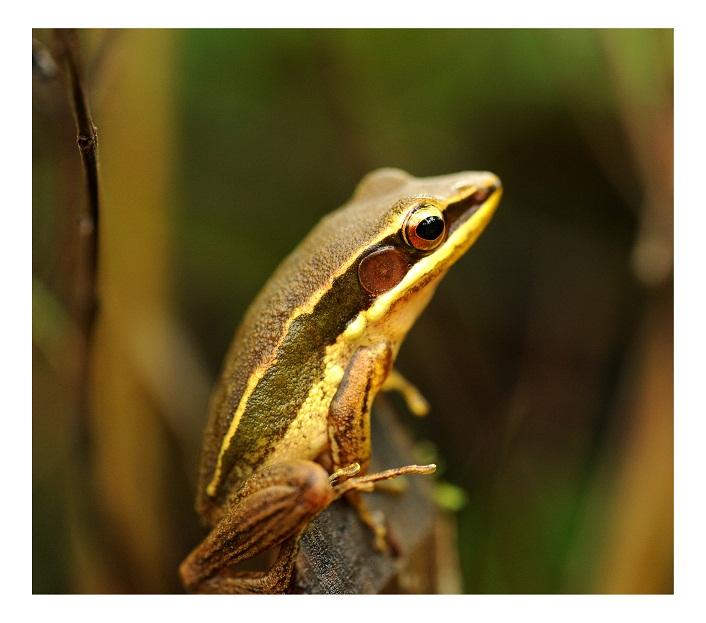
The Golden Frog
The Golden Frog (right) poses for an ardent admirer
Frogs have inspired fable, poetry and myth. And Sahastra, too. Back at Agumbe, he spent long meditative moments in the august (wasn't it June?) presence of the Golden Frog. And he came back with a lovely photo-essay on the species. Inspired by Matsuo Bashuo's immortal frog haiku, he wrote: "They were trusting, accessible and -- pardon me for anthropomorphising -- extremely friendly."
MORE >
Matsuo Basho's frog haiku (via Geishablog)
Imagine an amphibian that is frequently mistaken for a snake. In Kerala (where it is called iruthalamoori -- literally, two-headed ox) and parts of coastal Karnataka, caecilians are feared as fearsome two-headed snakes. The "heads" are in fact a pair of tentacles near the mouth, which aid the poor-sighted creature to feel its way around its dark, mulchy habitat.

Caecilian, you're breaking my heart!

At Agumbe we had the fortune of meeting the Bombay Caecilian, a purplish-black serpentine amphibian with moist, mucous-coated skin, thanks to the ARRS station manager Prashant. It was the experience of a lifetime.
MORE >


On Wednesday, the birds returned wordlessly to The Green Ogre, with Sandy showing us his picture of Racket-tailed Drongos on a monsoon date. Reminded me of that faux Japanese proverb from You Only Live Twice, quoted by Sean Connery playing 007: "Bird never make nest in bare tree."
The beautiful Nilgiri Flycatcher
In the dark, mysterious shola forests of the Nilgiris, you may chance upon a diminutive blue bird, bluer than the hills that take their name from the violet-blue blooms of Kurinji that bloom every 12 years. The Nilgiri Flycatcher is so beautiful it can make you catch your breath. As gnats and midges dance like dust motes in the cool shade of stream-watered sholas, the flycatcher hawks them with darts and sallies. Sandy regaled us with some lovely pictures. Also watch this video.
MORE >


The common Sand Boa that was saved from becoming a roadkill
Snakes are among the most common and least lamented of roadkills. And some, especially slow movers and those of nocturnal habit, are most susceptible to being run over by vehicles speeding carelessly on forest highways. Returning from a weekend trip Arun and a friend chanced upon a Common Sand Boa that was in grave risk of becoming a statistical addition to the list. "The sound that is produced as a vehicle runs over a snake is a sickening snap. I am glad I didn't have to hear it this time," he mused after they released the snake into the forest.
MORE >


Look out for more interesting posts next week. Enjoy your weekend (or what's left of it)!

Encounter: Common Sand Boa

True to its name the Sand Boa spends most of its life under the sand or in loose earth, and its tough skin offers protection while burrowing. I'm glad we didn't run over this fine snake


The Sand Boa where we found it

Six of us were driving back to Bangalore after a trip when Sunil shouted from the back seat, "Snake! Stop the car!" 


Khusro pulled over to the side and four of us ran back to the spot. In the available light Sunil and I tried to identify the snake. At first glance the stout body gave us the impression that it was a small Russell's Viper. Peering closer, aided by the head light of an oncoming vehicle, we determined that it was a Sand Boa (Eryx conicus).


We had to prevent it from becoming another all-too-common roadkill. While I stopped vehicles speeding past us, Sunil took off his tshirt, draped it over the snake and lifted it off the road. He has been working with snakes for a while and was comfortable handling the boa. We then put the snake in front of Khusro's vehicle. Under headlights, we checked it for injuries. It seemed all right. 

When Sunil put the snake down, it exhibited an odd behaviour. Rather than try to slither away, it coiled up between his shoes. This is the Sand Boa's defense strategy - to get into a hole or crevice and coil up, keeping its head protected within its coils. When handled the snake was aggressive and ready to strike.


The snake lashes out, trying to strike
It was only my fourth touch of a snake, but this felt different. The sturdy, muscular serpent had rough, hard scales. True to its name the Sand Boa spends most of its life under the sand or in loose earth, and its tough skin offers protection while burrowing. Its scales were rougher and harder than that of the other three snakes I had handled. Boas are thick, short snakes with rough, keeled scales. Although individuals up to 90 centimetres have been measured, on an average they grow to around 60 centimetres.

At first glance, they can be confused with Russell's Vipers but the viper has a clear pattern and a triangular, arrow-like head that is broader than the neck. The Sand Boa's head is hardly distinguishable from its neck. Its body is short and thick and it has a rounded snout and a short, tapering tail. The eyes are small with vertical slits in the pupil. The snake's upperparts are grey with large, irregular brown or reddish-brown blotches, which may or may not be joined.


Note the pattern on the back and the shape of the head
The Sand Boa is often mistaken for the venomous Russell's Viper and therefore killed. Other reasons for its declining numbers are the illegal trade in animals and poaching for its skin. These snakes are caught and sold as pets and their skin is coveted for making fancy purses and wallets.  


Sand Boas are a part of the subfamily Erycinae under a family of non-venomous snakes called Boidae. So, how do they kill their prey? The snake wraps its coils around its prey after restraining it by biting and holding with its several sharp teeth. Then it constricts the captured animal until it suffocates to death.


Sand Boas are found in arid and semi-arid regions and are generally active at dusk and night. They are ovoviviparous, producing 3-16 live young. The breeding season is usually November.

Ready for release
We took a few shots of the snake before releasing it away from the busy road. I have seen and heard snakes being run over. Yes, "heard". The sound that is produced as a vehicle runs over a snake is a sickening snap. I am glad I didn't have to hear it this time.


Text and photographs: Arun

Encounter: The Nilgiri Flycatcher

In the dark, mysteriously beautiful shola forests of the Nilgiris, look out for a little blue bird that will drive your blues away  


There's something common to the Nilgiris and this diminutive flycatcher -- the color blue. The Nilgiris -- literally Blue Hills -- get their name from the purple-blue flowers of the Kurinji (Strobilanthes kunthiana) that carpet their slopes once in 12 years. As for the male Nilgiri Flycatcher, it develops a dark metallic blue color as it reaches adulthood.


All my run-ins with the Nilgiri Flycatcher (Eumyias albicaudatus) have been in various parts of Ooty, which is part of the limited habitat that this bird occupies, and one reason why it has been classified as a near-threatened species in the IUCN Red list.

I saw it first on a trip to Mukurthi National Park, inside a small pocket of shola forest, as the bird hopped from one low branch to another looking for small winged insects. It was just one member of a mixed hunting flock. It soon disappeared into the dense undergrowth where it was too dark to discern anything.


I saw them in plenty in August 2009 on a couple of drives to Ooty. This time the sightings were elaborate, and it was exciting to watch them sally around catching insects on the wing, and letting out shrill warbles interspersed with sharp cheeps. A juvenile obliged me, letting me take a few snaps as it perched on a branch a few metres away from the road.
But the best sighting was this year in March when a two-day trip resulted in an hour-long encounter with a rotund male specimen, who hopped around quite close to us. First, it perched on some kind of hibiscus bush and later on a wall, often giving us curious glances, and letting us photograph him to our heart's content. 


The Little Blue Bird of the Blue Hills from Green Ogre on Vimeo.

Text and photographs by Sandeep Somasekharan
Video by Beej

Wordless Wednesday: Drongos on a date

Encounter: Bombay Caecilian, an amphibian epiphany

Its serpentine structure and moist, clammy skin gives the caecilian the appearance of a frog masquerading as a snake. Chances are you've seen this intriguing amphibian before but never taken a second look at it!
The head of the Bombay Caecilian, showing the tiny tentacles, mouth and the eyes. Note the ring-like folds on the skin and the whitish secretion of mucus
During our three days at the Agumbe Rainforest Research Station, breakfast conversations with station manager Prashant always yielded something interesting. On the morning of the day we were leaving I asked him casually about his work, and he mentioned in his characteristic unassuming manner that he had been part of the discovery and documentation of some species of Caecilians.

Caecilians! My ears perked up at the word. I hadn't heard it in a long time and something told me we were very close to an epiphany of sorts.

“Aren't they legless amphibians?” I asked.

“Yes,” he said laconically.

“And do you get them around here?”

“Yes.”

“Wish we could see them...” I murmured hopefully.

“I could show you one,” he said helpfully. “I have a pet.”

For the rest of the day we were at our best behaviour, grinning and glancing at Prashant hopefully every time we passed him. After lunch he asked us to wait outside a hut that probably served as a storage room for specimens. In its dim murkiness we saw him digging around in a bucket.


The caecilian's sinuous movements are very like a snake's
He came out of the hut holding a slender, purplish-black creature that resembled a snake at first glance. But unlike a snake's skin, which is dry and scaly, this animal's shiny body surface appeared to secrete mucus that rubbed off in white gobs on Prashant's hands. He invited me to touch it, and the skin felt soft, cool, slippery and moist under my fingertips. It was like touching a frog masquerading as a snake. This mucus is believed to be mildly toxic to predators, though that doesn't prevent pigs, snakes and chickens from eating some of the smaller caecilians.


Mucus, secreted by the caecilian's skin, keeps it moist while its mild toxicity is thought to deter predators
Though their snakelike appearance can be deceptive, caecilians are legless amphibians related to frogs, toads and salamanders. Their serpentine body structure is an adaptation for a burrowing lifestyle. They live among leaf litter and loose soil and can be found under fallen trees and rocks. There are 26 recorded species of caecilians in India, of which 25 are endemic and about 20 of these are found in the Western Ghats. Other caecilians have also been discovered from forests in Manipur and Nagaland in northeast India. 

The species we were admiring was the Bombay Caecilian (Ichthyophis bombayensis), which occurs in the Western Ghats. It was nearly a metre long – I had expected caecilians to be much smaller -- and the body is annulated (the skin is ringed with folds) as in worms. The two tiny eyes, barely more than dark spots sheathed by skin, are surrounded by pale white rings. This caecilian's eyesight is perhaps limited to distinguishing between darkness and light. The mouth has rows of small teeth that are adapted for holding and cutting prey, which primarily consists of earthworms, termites and small invertebrates that live in the soil. There are two tentacles close to the mouth and this has perhaps given rise to the myth that these are venomous two-headed snakes -- in Kerala they are known as iruthalamoori (literally, two-headed bullock) and killed because they are commonly mistaken for snakes (some resemble the similarly coloured shieldtail snakes).


Snake in the grass? Sadly, many caecilians are easily mistaken for snakes and therefore killed
Caecilians are oviparous, which means they lay eggs. It's hard to tell males and females apart externally, but males have a concealed copulatory organ, the phallodaeum, which can be inserted like a pseudo-penis into the aperture of the female during copulation. Fertilization takes place inside the female's body. As with most amphibians, caecilian eggs are strung together in gelatinous threads, like beads in a necklace. The female caecilian protects her clutch of eggs by coiling her body around them. The larvae are aquatic and free-swimming -- like tadpoles. 


If you happen to visit a plantation of areca, banana or coffee with moist, humus-rich soil and compost pits, look out for caecilians. Just remember that like all amphibians they are highly sensitive to depletion of soil quality and are therefore important environmental indicators.


Prashant treats us to a ampbibian epiphany

As we watched the caecilian with fascination, Prashant put it down on the ground. It moved swiftly through the grass and began looking for a place to hide away from the sunlight. He then put it back in its bucket and announced, "Show is over!"


Thanks, Prashant. We're all really grateful to you for introducing us to this intriguing amphibian. We have one more reason to keep our eyes glued to the ground in a rainforest. The birds can wait!


References:
A Field Guide to the Caecilians of the Western Ghats, India by Gopalakrishna Bhatta, Department of Zoology, Sri JCBM College, Sringeri, India


Text and additional photos: Beej
Lead photos: Sahastrarashmi
Read more Encounters and more posts from our Agumbe Diaries